AI tools for ecommerce are helping USA store owners create product descriptions, answer customer questions, improve marketing, analyze data, and automate repetitive work. Small ecommerce teams can use AI to handle tasks that once required several hours every week.
The opportunity is growing in 2026. Shopify reports that 75% of surveyed store owners were already using AI for activities such as content creation, data analysis, and store operations. AI shopping assistants, personalization, predictive analytics, and AI agents are also becoming important parts of ecommerce.
A Shopify store selling skincare products, for example, can use AI to create product copy, generate social media ideas, answer shipping questions, segment customers, and build email campaigns.
AI does not replace good products, customer service, or business strategy. It makes those activities faster and easier to manage.
What Are AI Tools for Ecommerce?
AI tools for ecommerce are software applications that use artificial intelligence to help online retailers perform business tasks.
Common uses include:
- Product description generation
- SEO content creation
- Customer support
- Email and SMS marketing
- Product recommendations
- Image creation and editing
- Competitor research
- Sales forecasting
- Customer segmentation
- Inventory and store analysis
- Ad copy creation
- Workflow automation
The best tool depends on the problem a store needs to solve. Shopify identifies different AI options for store management, content, customer service, marketing visuals, research, and automation rather than treating one platform as the answer for every ecommerce task.
Best AI Tools for Ecommerce Stores in the USA
1. Shopify Magic and Sidekick — Best AI for Shopify Stores
Additionally, Shopify Magic provides AI features across store building, marketing, customer support, and back-office activities. Shopify states that its Magic tools are available at no additional cost, although individual feature availability can vary.
Sidekick can help merchants with store-related questions, content, customer segmentation, and other administrative tasks.
Best features:
- AI-generated product content
- Store management assistance
- Marketing copy
- Customer segmentation
- Theme and media assistance
- Business guidance
Real-world example: A US clothing store can ask Sidekick to help create descriptions for a new collection instead of writing every product page from scratch.
Pros:
- Built into Shopify
- Easy for beginners
- No separate AI platform required for many features
- Useful for daily store operations
Cons:
- Primarily valuable for Shopify merchants
- Advanced marketing needs may require additional tools
2. ChatGPT — Best All-Purpose Ecommerce AI
ChatGPT is useful for ecommerce businesses that need flexible AI assistance. Shopify reported that ChatGPT led AI tool usage among store owners in its Q4 2025 survey, with 67% using it.
Store owners can use it for product descriptions, customer-service drafts, keyword research, promotional ideas, business analysis, FAQs, email campaigns, and social content.
ChatGPT Plus is currently $20 per month and provides broader model and tool access than the Free plan.
Best features:
- Product copy
- SEO brainstorming
- Email writing
- Customer-service responses
- Competitor research
- Marketing ideas
- Data analysis
- Content planning
Real-world example: A US electronics retailer can provide product specifications and ask ChatGPT to create a clear product description, five ad headlines, an FAQ, and an email announcement.
Pros:
- Extremely flexible
- Easy to use
- Useful across departments
- Affordable starting point
Cons:
- Requires human fact-checking
- Not a complete ecommerce platform
- Results depend on prompts and information provided
3. Klaviyo — Best AI for Ecommerce Email Marketing
Klaviyo is designed around customer data, email, SMS, personalization, and ecommerce marketing.
Its platform supports ecommerce brands that want to build automated customer journeys based on shopping behavior. Klaviyo’s billing structure can include profiles, email, mobile messaging, reviews, analytics, customer data, and customer-agent products.
Best features:
- Automated email campaigns
- SMS marketing
- Customer segmentation
- Personalized messaging
- Ecommerce analytics
- Marketing automation
- AI-assisted campaign workflows
Real-world example: A US beauty brand can automatically send a welcome email to a new subscriber, a product reminder to a shopper who abandoned a cart, and a personalized campaign to previous buyers.
Pros:
- Strong ecommerce focus
- Excellent customer segmentation
- Email and SMS automation
- Useful for growing stores
Cons:
- Pricing increases as customer data and usage grow
- Can require setup and marketing knowledge
4. Canva — Best AI Design Tool for Ecommerce Marketing
Ecommerce businesses need visual content for product launches, social media, advertisements, email campaigns, and websites.
Canva’s AI-powered design features can help merchants create and edit marketing assets without advanced graphic-design skills.
Best features:
- Social media designs
- Product marketing graphics
- AI image generation
- Background removal
- Promotional banners
- Presentation and campaign assets
- Brand templates
Real-world example: A US home-decor store launching a Labor Day promotion can create Instagram graphics, website banners, promotional posts, and email visuals from reusable brand templates.
Pros:
- Beginner-friendly
- Fast design workflow
- Large template library
- Useful for small marketing teams
Cons:
- Advanced brand requirements may need a paid plan
- AI-generated visuals still need quality review
5. Jasper — Best AI for Ecommerce Marketing Content
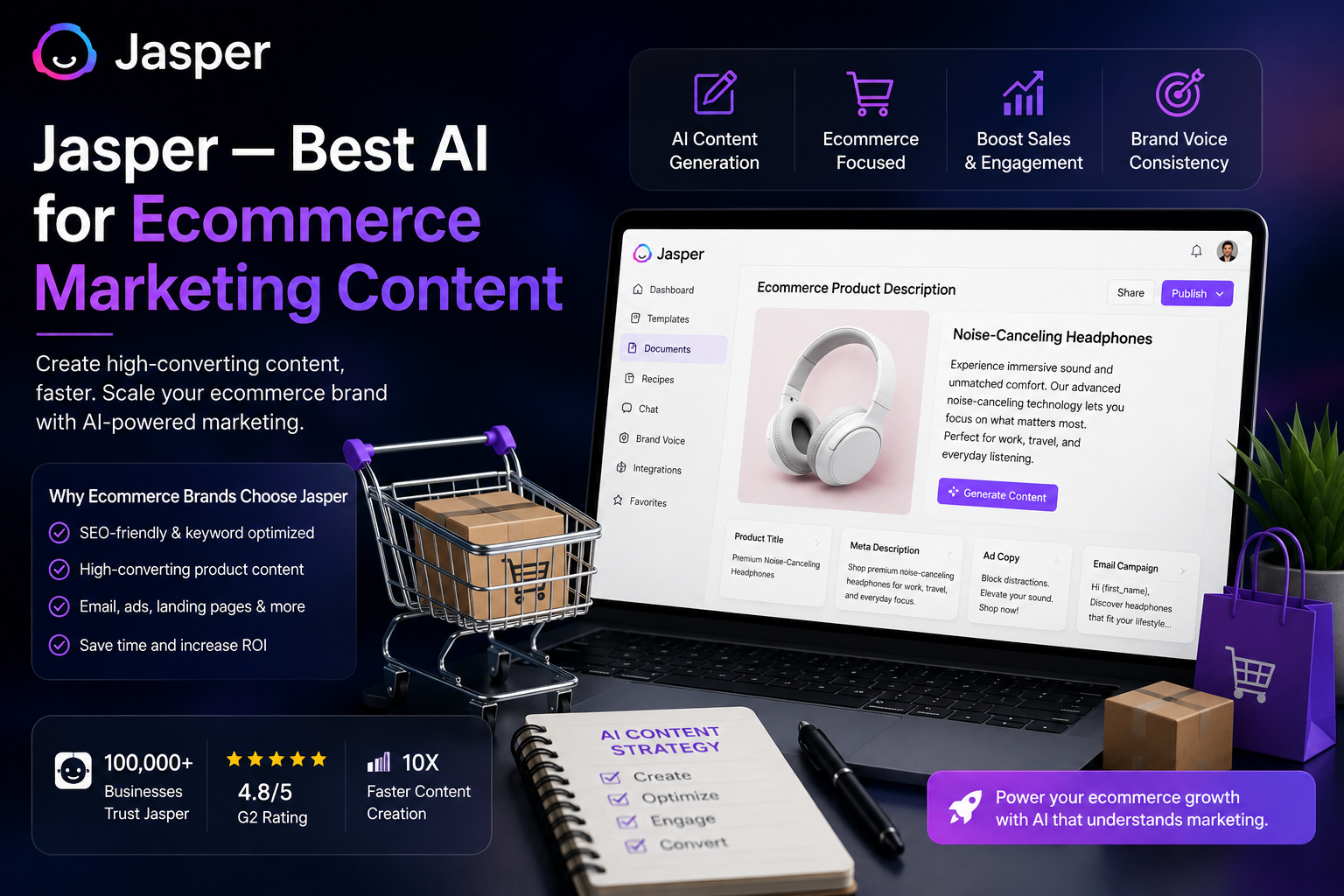
Additionally, Jasper focuses heavily on marketing content and brand consistency. It can help ecommerce teams create website copy, campaigns, advertisements, email content, and other marketing materials.
Jasper’s current Pro plan is listed at $69 per month when billed monthly or $59 per month when billed annually. Business pricing is customized.
Best features:
- Marketing content
- Brand voice
- Campaign creation
- AI agents
- Content repurposing
- Image generation and editing
- Marketing workflows
Real-world example: A US fashion brand can establish its brand voice and use Jasper to create consistent product campaigns across website pages, email, and social media.
Pros:
- Strong marketing focus
- Brand voice controls
- Good for larger content teams
- Supports multiple marketing workflows
Cons:
- More expensive than general-purpose AI
- May be unnecessary for very small stores
6. Gorgias — Best AI Customer Support for Ecommerce
Gorgias is designed specifically for ecommerce customer service. Its AI Agent can resolve certain customer conversations automatically while human agents handle more complicated cases.
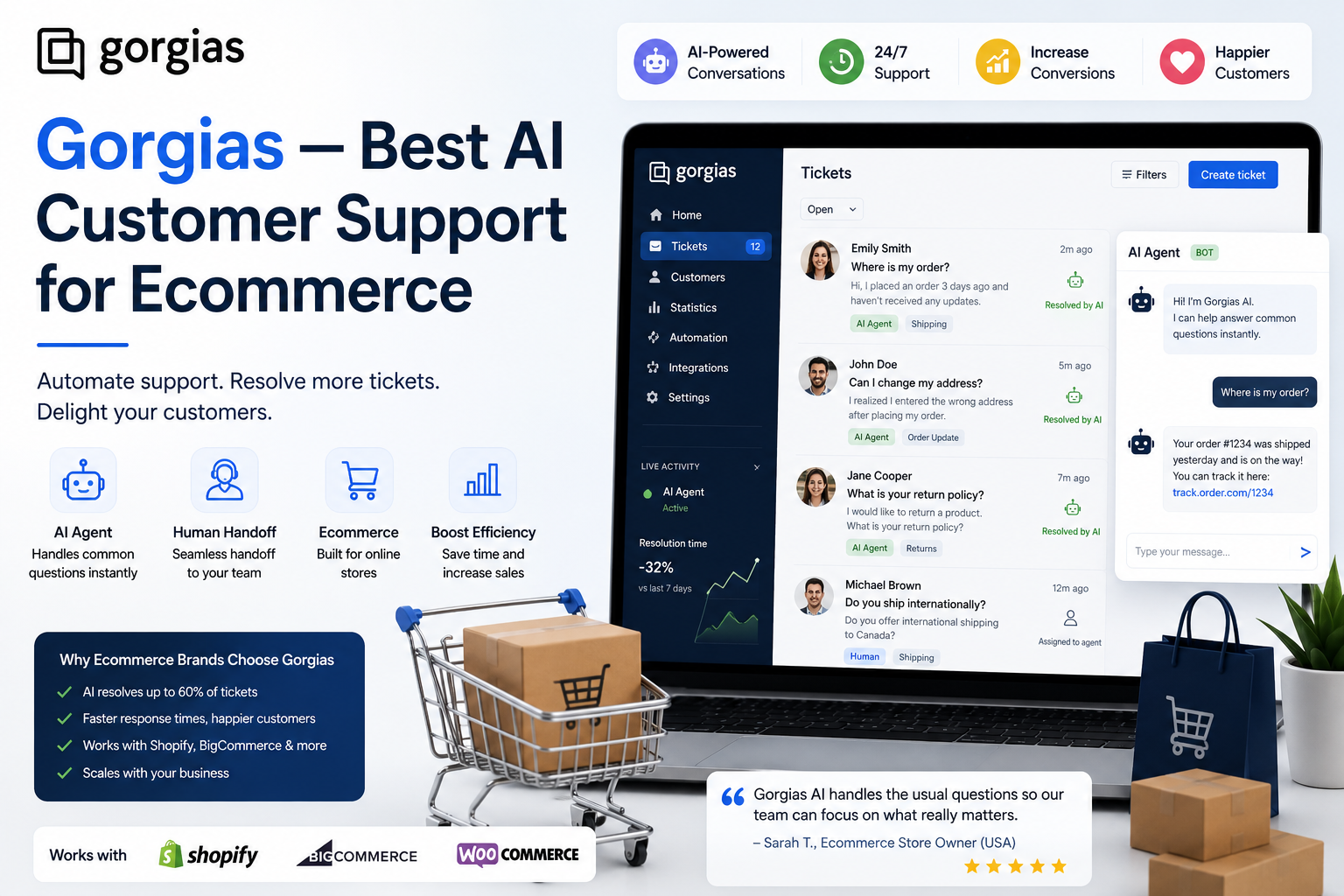
Gorgias currently uses usage-based pricing for AI Agent. Most plans charge about $0.90 per AI-resolved interaction with annual billing or $1 per interaction with monthly billing, while Starter begins at $1 per resolved interaction.
Best features:
- AI customer support
- Order questions
- Returns assistance
- Email support
- Chat support
- SMS support
- Human handoff
- Ecommerce integrations
Real-world example: A US apparel store can let AI handle common questions about order status, shipping, and returns while employees focus on complaints and complex customer issues.
Pros:
- Ecommerce-focused
- 24/7 automated support
- Human handoff
- Usage-based AI pricing
Cons:
- Costs rise with support volume
- Setup requires accurate store information
AI Ecommerce Tools Feature Comparison
| AI Tool | Best For | Content | Marketing | Support | Shopify |
|---|---|---|---|---|---|
| Shopify Magic/Sidekick | Store operations | Excellent | Good | Good | Excellent |
| ChatGPT | General AI work | Excellent | Excellent | Good | Via integrations |
| Klaviyo | Email and SMS | Good | Excellent | Good | Excellent |
| Canva | Visual marketing | Good | Excellent | Limited | Via integrations |
| Jasper | Marketing content | Excellent | Excellent | Limited | Via integrations |
| Gorgias | Customer service | Good | Good | Excellent | Excellent |
Pros and Cons of AI Tools for Ecommerce
Pros
- Reduce repetitive work
- Create content faster
- Improve customer response times
- Support personalized marketing
- Help small teams scale
- Generate more marketing ideas
- Automate routine customer-service tasks
- Improve store productivity
Cons
- AI can produce inaccurate information
- Subscription costs can increase
- Poor prompts can create weak content
- Customer data requires careful handling
- Human review remains important
- Too many tools can create a complicated tech stack
AI Ecommerce Tools Performance Comparison
Performance depends on the store, data quality, integrations, and implementation. A practical comparison looks like this:
| Tool | Ease of Use | Automation | Content Quality | Ecommerce Focus |
|---|---|---|---|---|
| Shopify Magic/Sidekick | 5/5 | 5/5 | 4/5 | 5/5 |
| ChatGPT | 5/5 | 3/5 | 5/5 | 4/5 |
| Klaviyo | 4/5 | 5/5 | 4/5 | 5/5 |
| Canva | 5/5 | 4/5 | 5/5 | 4/5 |
| Jasper | 4/5 | 4/5 | 5/5 | 4/5 |
| Gorgias | 4/5 | 5/5 | 4/5 | 5/5 |
These scores are practical editorial ratings, not vendor-published benchmarks.
AI Tools for Ecommerce Pricing Comparison
| Tool | Starting/Typical Price | Best For |
|---|---|---|
| Shopify Magic | Included with Shopify | Store AI |
| ChatGPT | Free; Plus $20/month | General AI |
| Klaviyo | Usage-based | Email/SMS |
| Canva | Free and paid plans | Design |
| Jasper | $69/month monthly; $59/month annual | Marketing |
| Gorgias AI Agent | From about $0.90–$1 per resolved interaction on most plans | Support |
Pricing can change by plan, usage, billing cycle, region, and product configuration. Shopify Magic is available without an additional AI charge, while Klaviyo and Gorgias use usage-related pricing models.
How to Choose AI Tools for Your US Ecommerce Store
Start with the biggest operational problem.
A new Shopify store may only need Shopify Magic, Sidekick, Canva, and ChatGPT. A growing brand with thousands of customers may benefit from Klaviyo for retention and Gorgias for support.
Use this approach:
- Need better product descriptions? Choose ChatGPT, Shopify Sidekick, or Jasper.
- Need better marketing graphics? Choose Canva.
- Need automated email marketing? Choose Klaviyo.
- Need customer support automation? Choose Gorgias.
- Need Shopify store assistance? Choose Shopify Magic and Sidekick.
- Need a flexible AI assistant? Choose ChatGPT.
Start with one workflow. Measure time saved, conversion impact, customer response speed, and marketing performance before adding more software.
FAQs About AI Tools for Ecommerce
1. What are the best AI tools for ecommerce in 2026?
The best options depend on the task. Shopify Magic and Sidekick are strong for Shopify operations, ChatGPT is excellent for flexible AI work, Klaviyo is strong for ecommerce marketing, Canva is useful for visual content, Jasper focuses on marketing, and Gorgias is built for customer support.
2. Can AI increase ecommerce sales?
AI can support sales by improving product content, personalization, customer service, recommendations, and marketing automation. It does not guarantee higher sales. Product quality, pricing, customer trust, traffic, and the overall shopping experience still matter.
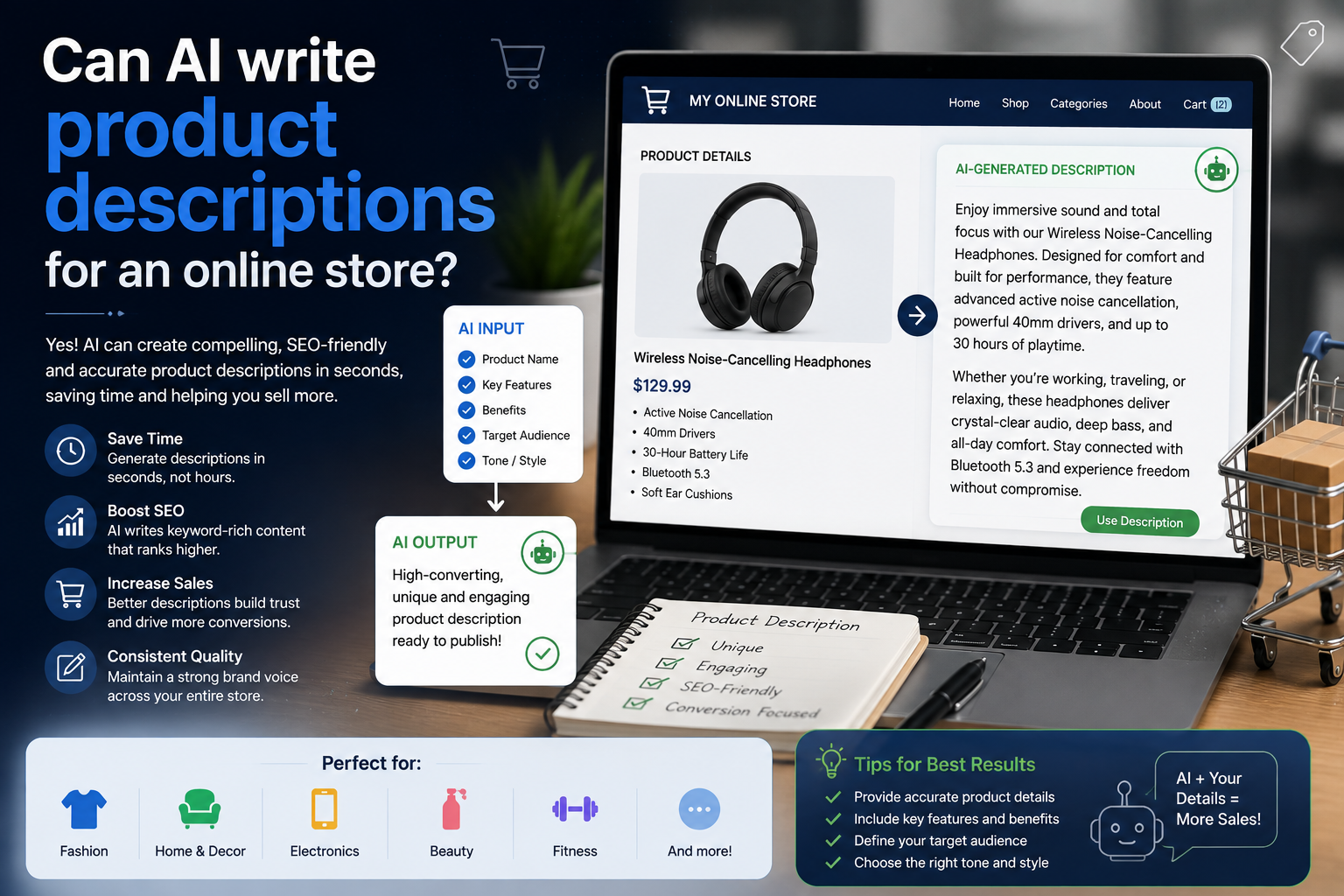
3. Can AI write product descriptions for an online store?
Yes. AI can create product descriptions from specifications, benefits, features, target customers, and brand guidelines. Store owners should verify product claims, measurements, materials, warranties, and other factual information before publishing.
4. What is the best AI tool for Shopify stores?
Shopify Magic and Sidekick are strong starting points because they are integrated into Shopify. Shopify also recommends tools such as ChatGPT, Canva, Gorgias, Tidio, and other specialized solutions for different ecommerce tasks.
5. Will AI replace ecommerce employees?
AI is more likely to change ecommerce jobs than eliminate every role. Routine content, support, research, and administrative tasks can be automated. Human employees remain valuable for strategy, creative decisions, relationship building, complex support, merchandising, and business management.
Conclusion: Which AI Ecommerce Tool Wins?
There is no single winner for every USA ecommerce store.
Shopify Magic and Sidekick win for Shopify store operations. They offer an accessible AI foundation without requiring another major platform.
ChatGPT wins for flexibility. It can support product content, research, marketing, customer communication, and business planning.
Klaviyo wins for retention marketing. Stores focused on email, SMS, segmentation, and customer journeys can build powerful automated campaigns.
Canva wins for ecommerce design. It makes professional-looking marketing assets easier for small teams.
Jasper wins for marketing teams that need brand-focused content at scale.
Gorgias wins for ecommerce customer support. Its AI Agent can handle qualifying customer conversations and pass complex issues to human agents.
The strongest strategy for a USA online store is not collecting every AI subscription. Choose the tools that solve your highest-value problems. Connect them to your existing ecommerce workflow. Review AI-generated work. Track results.
AI is becoming part of everyday ecommerce operations in 2026. Stores that use it strategically can spend less time on repetitive tasks and more time improving products, customer experience, and growth.