AI tools for doctors are changing how physicians in the USA handle documentation, research, patient communication, and daily administrative work. Many doctors spend valuable time typing notes, reviewing records, preparing summaries, and completing repetitive paperwork instead of focusing fully on patients. Canva vs Adobe Express: Best Design Tool for 2026
Modern medical AI can help with some of these tasks. Tools such as Microsoft Dragon Copilot, Abridge, and ChatGPT for Healthcare can support clinical documentation and other healthcare workflows. OpenAI launched ChatGPT for Healthcare in 2026 with features designed for regulated healthcare environments, including HIPAA-supporting controls and trusted clinical search.
The important point is simple: AI should assist doctors, not replace medical judgment. The American Medical Association recommends appropriate oversight, education, risk management, privacy protection, and qualified human involvement when AI is used in healthcare
AI Tools for Financial Advisors USA: Best 2026 Picks
What Are AI Tools for Doctors?
AI tools for doctors are software applications that use artificial intelligence to help physicians complete healthcare-related tasks.
Depending on the product, these tools can:
- Create clinical notes from patient conversations
- Convert speech into medical documentation
- Summarize patient records
- Search medical literature
- Draft patient instructions
- Help prepare prior authorization documents
- Organize clinical information
- Support administrative workflows
- Provide evidence-based information
- Assist with coding and billing workflows
- Generate follow-up summaries
A major category in 2026 is ambient clinical documentation. The doctor speaks naturally with the patient, and the AI creates a draft note for physician review. Microsoft Dragon Copilot, for example, combines ambient listening, voice dictation, and generative AI for clinical workflows.
Abridge takes a similar documentation-focused approach and also offers clinical decision-support capabilities and post-visit workflows.
Best AI Tools for Doctors in the USA
There is no single AI platform that is best for every physician. A primary-care doctor may prioritize ambient notes, while a hospital system may need enterprise security, EHR integration, governance, and clinical evidence.
| AI tool | Best for | Main strengths | Typical buyer |
|---|---|---|---|
| Microsoft Dragon Copilot | Clinical documentation | Ambient notes, dictation, workflow support | Physicians and health systems |
| Abridge | Ambient documentation | Clinical notes, evidence context, post-visit workflows | Clinics and health systems |
| ChatGPT for Healthcare | Clinical and administrative AI | Research, summaries, drafting, cited medical information | Healthcare organizations |
| Nabla Copilot | AI medical scribe | Ambient documentation and note generation | Individual clinicians and practices |
| General AI assistants | Non-PHI productivity | Writing, brainstorming, organization | General office work |
The right choice depends on your specialty, EHR, patient volume, security requirements, and budget.
Medical AI Features Doctors Should Look For
1. AI Medical Scribe and Clinical Notes
Documentation is one of the clearest use cases for medical AI.
A doctor can have a patient conversation while an ambient AI system captures relevant information and prepares a draft note. Dragon Copilot, for example, can turn recorded patient conversations into clinical documentation that the physician reviews before use
Best AI Tools for Real Estate Agents USA 2026
Useful features include:
- SOAP note generation
- Specialty-specific templates
- Voice dictation
- Patient conversation capture
- Transcript review
- EHR workflow integration
- Custom note preferences
2. Clinical Research and Medical Information
AI can reduce the time doctors spend searching through large amounts of information.
ChatGPT for Healthcare is designed to provide cited answers from medical literature, clinical guidelines, and public-health sources.
A physician could use an appropriate healthcare AI platform to help organize evidence about a treatment question, summarize research, or prepare questions for further review.
The doctor remains responsible for checking the evidence and making the clinical decision

3. Patient Communication
AI can also help doctors prepare understandable patient materials.
For example, a physician could create a plain-English explanation of a complicated procedure, discharge instructions, or follow-up information. The doctor should review the content before giving it to a patient.
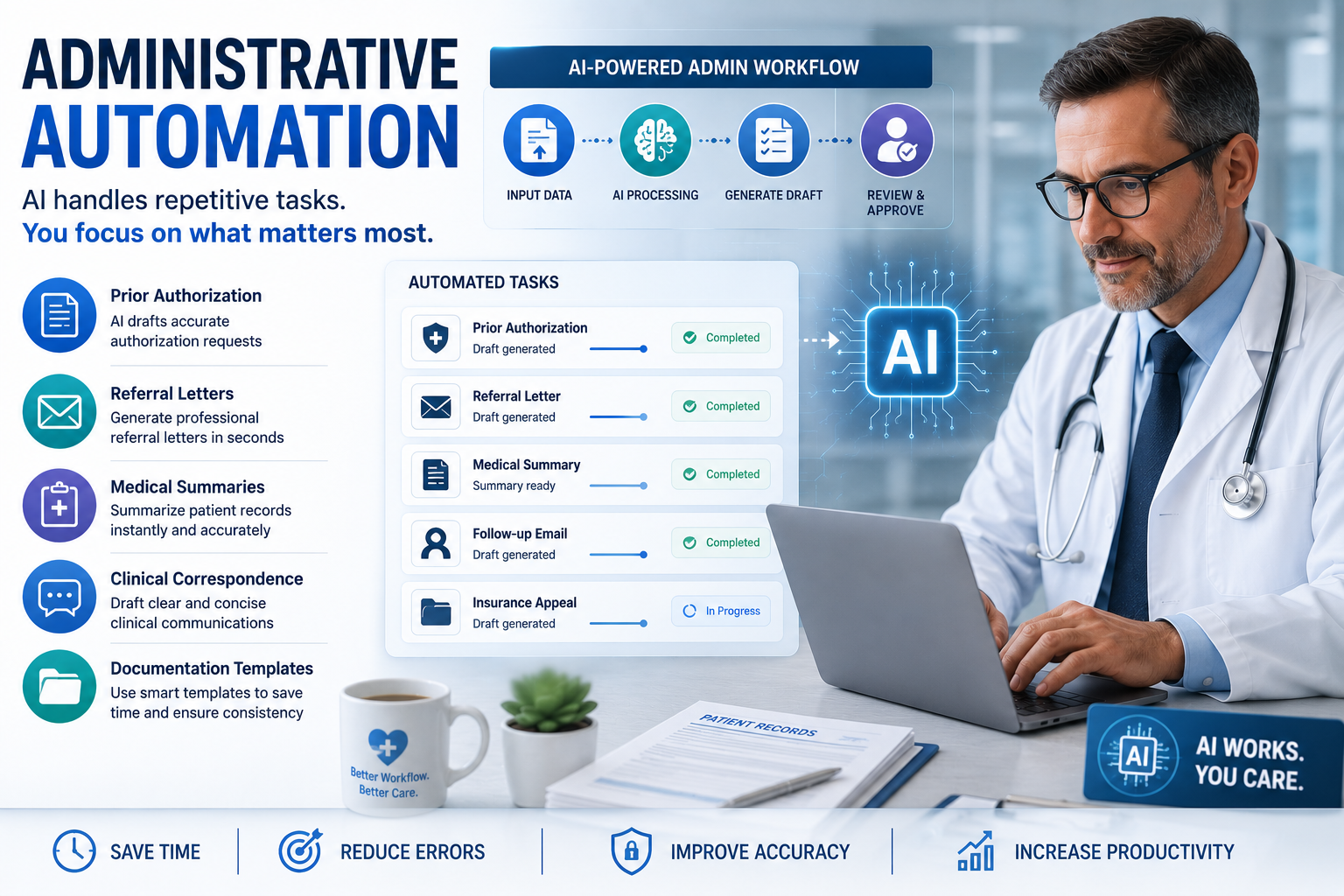
4. Administrative Automation
AI tools can help with repetitive administrative tasks such as:
- Prior authorization drafts
- Referral letters
- Medical summaries
- Clinical correspondence
- Documentation templates
- Administrative summaries
- Workflow organization
OpenAI says its healthcare products can support workflows such as chart summarization, discharge workflows, care coordination, and prior authorization support
Best Free AI Tools for Students 2026
AI Tools for Doctors: Pros and Cons
Pros
- Less documentation time: AI can prepare draft clinical notes.
- Better workflow: Physicians can spend less time switching between tasks.
- Faster information access: AI can organize large amounts of information.
- Patient communication: Drafting plain-language materials becomes easier.
- Scalability: Health systems can standardize repetitive workflows.
- Voice-based documentation: Doctors can speak naturally instead of typing everything.
Cons
- AI can make mistakes.
- Generated information requires professional review.
- Privacy and security must be carefully managed.
- Some advanced products require enterprise contracts.
- EHR integration can be complicated.
- Staff need training before deployment.
- AI output can create legal and clinical risks if used without proper oversight.
The AMA specifically warns that generative AI can produce inaccurate or misleading information and recommends governance policies, staff education, privacy protections, and appropriate oversight.
AI Medical Tools Performance Comparison
Performance should not be judged only by how impressive an AI demonstration looks. Doctors should consider accuracy, workflow fit, documentation quality, integration, security, and the amount of editing required.
| Tool | Documentation | Research | Workflow | Enterprise readiness | Best use |
|---|---|---|---|---|---|
| Dragon Copilot | Excellent | Good | Excellent | Excellent | Clinical documentation |
| Abridge | Excellent | Good | Excellent | Excellent | Ambient clinical workflows |
| ChatGPT for Healthcare | Very good | Excellent | Excellent | Excellent | Research and broad AI workflows |
| Nabla Copilot | Excellent | Good | Very good | Very good | AI medical scribing |
| General AI tools | Good | Very good | Good | Depends on product | Non-clinical tasks |
These ratings are practical comparisons rather than clinical accuracy scores. Healthcare organizations should conduct their own evaluation before deployment.
Abridge says its platform uses provenance tracking so clinicians can validate generated documentation against the underlying conversation, while its evaluation program focuses on accuracy and safety.
AI Tools for Doctors Pricing in the USA
Pricing changes frequently, and several enterprise healthcare products do not publish a simple public price.
| AI tool | Pricing approach | Public price information |
|---|---|---|
| Microsoft Dragon Copilot | Per-user and consumption-based options | Contact Microsoft/sales |
| Abridge | Enterprise healthcare pricing | Contact sales |
| ChatGPT for Healthcare | Enterprise pricing | Contact sales |
| Nabla Copilot | Subscription-based | Check current plan |
| General AI tools | Monthly or enterprise plans | Varies by provider |
Microsoft currently documents both a per-user Dragon Copilot physician license and a consumption-based Physician PAYG option.
For a US medical practice, price should not be the only consideration. Calculate the total cost of ownership, including setup, integration, training, security review, support, and staff time.
Real-World Example: A Primary Care Doctor
Imagine a primary-care physician in Texas seeing 20 to 25 patients each day.
The physician spends several hours after clinic finishing notes. An ambient AI scribe can listen to the patient encounter and produce a draft clinical note.
The doctor reviews:
- Symptoms
- Medical history
- Assessment
- Plan
- Medications
- Follow-up instructions
The physician corrects errors and approves the final documentation.
This does not eliminate the doctor’s responsibility. It moves some of the typing and organization work to AI.
Microsoft specifically describes Dragon Copilot as generating draft clinical output that should be reviewed by healthcare professionals.
Real-World Example: A Hospital System
Consider a large hospital network operating multiple clinics.
The organization may need more than an AI scribe. It could need:
- Centralized access controls
- User permissions
- Audit logs
- EHR integration
- Data governance
- Security controls
- Standardized prompts
- Clinical evidence sources
- Organization-wide policies
This is where enterprise healthcare AI becomes more valuable than a consumer chatbot.
OpenAI’s healthcare offering includes role-based access controls, SSO, audit logs, data residency options, customer-managed encryption keys, and BAA support for eligible healthcare use.
HIPAA and AI for Doctors
HIPAA compliance should be a major consideration when selecting AI tools for a US medical practice.
Doctors should not assume that every AI chatbot is automatically suitable for protected health information.
Before entering PHI into an AI system, a healthcare organization should check:
- Whether the vendor supports a BAA
- How PHI is stored
- How data is encrypted
- Whether data is used for model training
- Where data is processed
- User-access controls
- Audit capabilities
- Data retention policies
- EHR integration security
- Vendor security documentation
OpenAI states that its HIPAA-eligible products can operate under a Business Associate Agreement, including ChatGPT for Healthcare and certain API configurations.
For additional guidance, healthcare organizations can review the AMA’s AI ethics and clinical practice resources and applicable federal requirements.
How Doctors Can Choose the Right Medical AI Tool
A good evaluation process starts with the actual problem.Choose an AI medical scribe if:
- Documentation takes too much time.
- Doctors spend evenings finishing charts.
- Your practice wants ambient note generation.
- Voice documentation is important.
Enterprise healthcare AI if:
- You operate multiple locations.
- You need centralized governance.
- Your organization handles large amounts of PHI.
- You require advanced access controls.
- You need broad clinical and administrative workflows.
research-focused AI if:
- Your work involves medical literature.
- You frequently summarize studies.
- You need help organizing evidence.
- Your team performs clinical research.
Ask vendors these questions
- Does the product support a BAA?
- What EHRs does it integrate with?
- How is AI output evaluated?
- Can doctors review the source transcript?
- What happens to patient data?
- Can administrators control access?
- What is the cancellation policy?
- What support is included?
- Does pricing change with usage?
FAQs About AI Tools for Doctors
1. What are the best AI tools for doctors in the USA?
The best option depends on the job. Dragon Copilot and Abridge are strong choices for clinical documentation. ChatGPT for Healthcare is designed for broader clinical, research, and administrative workflows. Nabla Copilot is another option for AI-assisted medical documentation.
2. Can doctors use AI for clinical documentation?
Yes. AI medical scribes can create draft notes from patient conversations. The physician should review, correct, and approve the documentation before it becomes part of the medical record. Microsoft explicitly describes Dragon Copilot output as AI-generated content requiring professional review.
3. Are AI tools for doctors HIPAA compliant?
Not automatically. HIPAA suitability depends on the specific product, configuration, vendor agreement, and use case. Healthcare organizations should verify BAA availability, security controls, data handling, and retention policies before using PHI.
4. Can AI replace doctors?
No. AI can automate selected tasks, but diagnosis, treatment decisions, patient communication, and professional responsibility still require qualified healthcare professionals. The AMA supports AI as augmented intelligence that helps healthcare professionals rather than replacing them.
5. Will AI reduce doctors’ administrative workload?
It can. Documentation, summaries, letters, research assistance, and repetitive administrative tasks are among the areas where AI can provide practical support. The actual time savings depend on the specialty, workflow, AI accuracy, and quality of integration.
Conclusion: Which AI Tool Wins?
The best AI tools for doctors in the USA depend on the physician’s workflow.
For ambient clinical documentation, Microsoft Dragon Copilot and Abridge are strong choices. Both focus heavily on turning patient-clinician conversations into useful clinical documentation.
For broader healthcare AI, ChatGPT for Healthcare stands out because it combines clinical information capabilities with enterprise governance and HIPAA-supporting features.
For doctors, the winner is not necessarily the AI with the most features. The better choice is the tool that fits the existing EHR, protects patient information, produces reliable drafts, reduces administrative work, and keeps the physician firmly in control.