AI tools for healthcare marketing are changing how hospitals, medical practices, health systems, clinics, telehealth companies, and healthcare brands reach people in the USA. Healthcare marketing teams often need to create educational content, manage social media, send email campaigns, improve search visibility, analyze customer behavior, and generate leads with limited time and staff.
AI can reduce the time spent on repetitive marketing work. It can help a small medical practice create a monthly content calendar or help a large healthcare organization personalize campaigns for different audiences.
The important point is simple: AI should support healthcare marketers, not replace human review. Healthcare content must be accurate, trustworthy, privacy-conscious, and appropriate for the audience.
The best tools combine AI writing, marketing automation, analytics, design, personalization, and campaign management
What Are AI Tools for Healthcare Marketing?
AI tools for healthcare marketing are software platforms that use artificial intelligence to help healthcare organizations plan, create, distribute, personalize, or measure marketing campaigns.
Common uses include:
- Writing healthcare blog drafts
- Creating social media posts
- Developing email campaigns
- Generating marketing ideas
- Creating graphics and campaign concepts
- Improving SEO content
- Segmenting audiences
- Automating marketing workflows
- Analyzing campaign performance
- Supporting lead generation
- Monitoring brand visibility in AI search
For example, a family medicine clinic in Texas could use AI to create a content plan around preventive care, seasonal health topics, and common patient questions. A hospital marketing department could use AI to create different versions of an educational email for patients, referring physicians, and community members.
AI is most useful when marketing teams combine automation with human approval.
Best AI Healthcare Marketing Tools in the USA
There is no single tool that is perfect for every healthcare organization. The right choice depends on team size, budget, marketing channels, workflow, and data requirements.
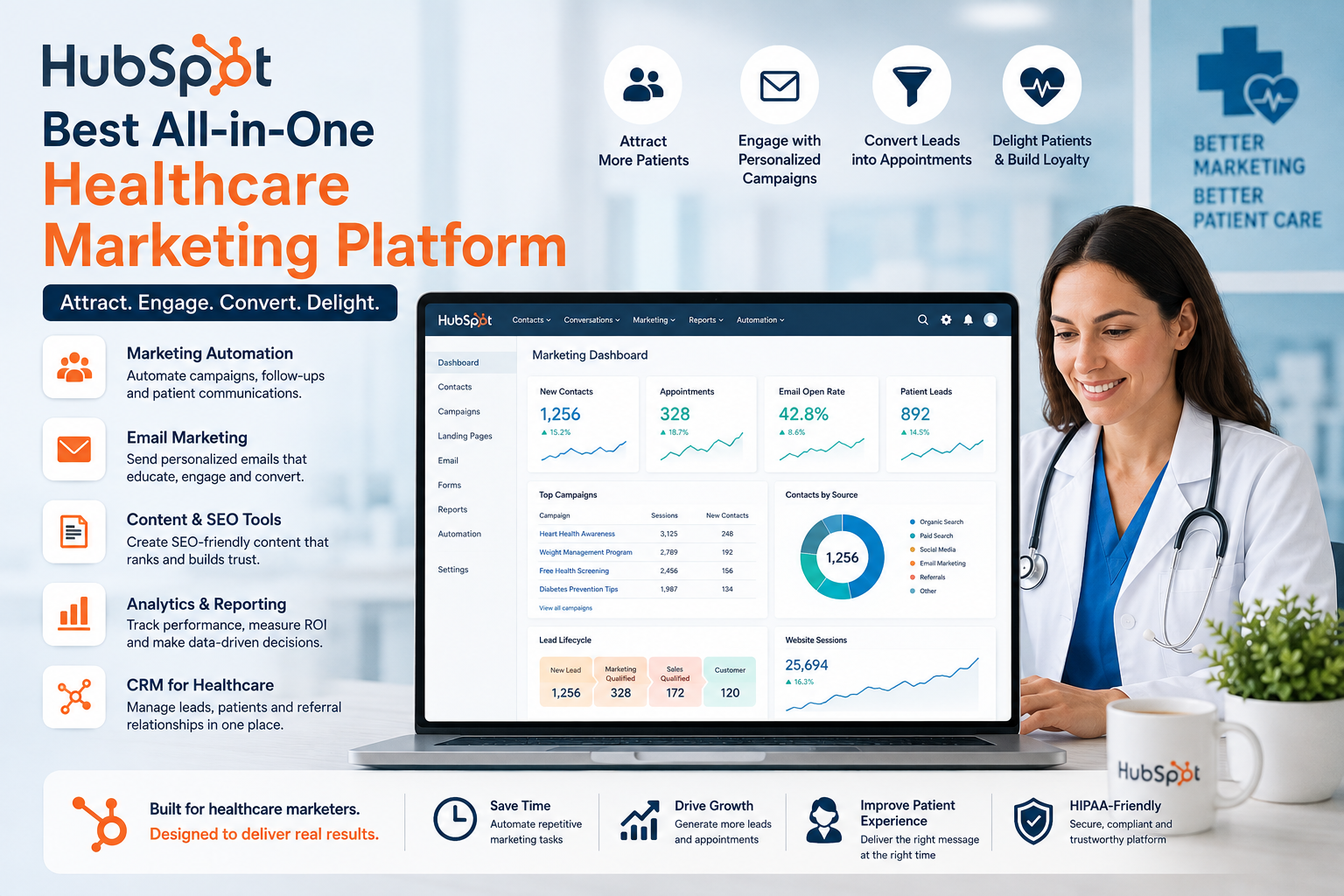
1. HubSpot — Best All-in-One Healthcare Marketing Platform
HubSpot currently offers a free plan, Starter, Professional, and Enterprise options. Its current pricing page lists Marketing Hub Professional starting at $800 per month when billed annually and Enterprise at $3,600 per month, with included HubSpot Credits for AI-powered features.
Healthcare marketing teams can use HubSpot for:
- Lead capture
- Email automation
- Website campaigns
- Audience segmentation
- Social media management
- AI-assisted content
- Customer and prospect data
- Campaign reporting
- AI search visibility tracking
HubSpot also offers an AEO product designed to help marketers understand visibility across AI search engines such as ChatGPT, Gemini, and Perplexity
2. Mailchimp — Best for Healthcare Email Marketing
Mailchimp currently has Free, Essentials, Standard, and Premium plans. Its current US pricing shows Essentials starting at $13 per month, Standard at $20 per month, and Premium at $350 per month for the displayed promotional pricing period.
Features include:
- Email campaigns
- Marketing automation
- Audience segmentation
- Generative AI features on eligible plans
- Email templates
- Campaign testing
- Customer insights
- More than 300 integrations
A dental practice, for example, could use email automation to remind subscribers about educational content, seasonal campaigns, or practice announcements.
3. ChatGPT — Best for Marketing Content and Ideas
ChatGPT can help healthcare marketers brainstorm campaign ideas, draft blog structures, create social captions, rewrite copy, generate FAQs, develop interview questions, and analyze marketing concepts.
A healthcare marketer could ask AI to create ten blog topics around heart health for a US audience. The marketer can then fact-check the information, add approved medical sources, and send the final content through the organization’s review process.
ChatGPT is particularly useful for:
- Content planning
- Blog outlines
- Social media ideas
- Ad copy drafts
- Email drafts
- FAQ development
- Campaign brainstorming
- Content repurposing
Healthcare organizations should have clear policies about what information employees can enter into AI systems.
4. Jasper — Best for Brand-Focused Marketing Content
Jasper is designed around marketing content and brand consistency. It can help marketing teams produce campaigns, advertising copy, website content, and other marketing materials.
It can be useful for a healthcare organization with several marketers who need consistent language across multiple channels.
A healthcare marketing team could create brand guidelines and use them when producing:
- Landing pages
- Paid advertising copy
- Social media campaigns
- Email content
- Blog drafts
- Promotional campaigns
Healthcare claims still require human review. AI-generated wording should never be treated as automatically approved medical or regulatory language AI Tools for Law Firms USA
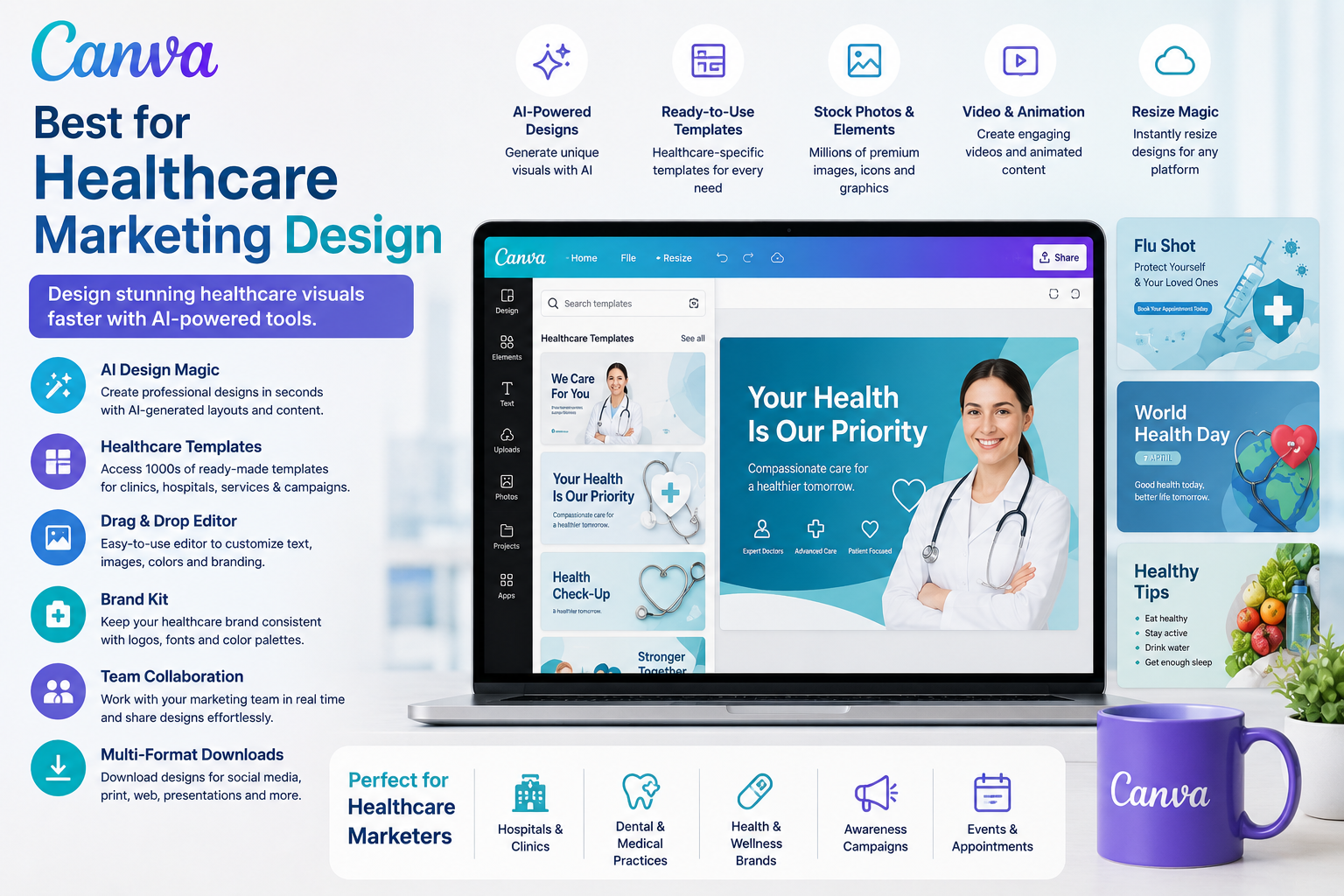
5. Canva — Best for Healthcare Marketing Design
Canva is useful for healthcare organizations that need fast visual content without maintaining a large graphic design team.
Marketing staff can use AI-assisted design tools to create concepts for:
- Instagram graphics
- Facebook posts
- Educational infographics
- Presentation slides
- Blog graphics
- Event promotions
- Healthcare awareness campaigns
For example, a community hospital could create a visually consistent campaign for a local health screening event.
AI Healthcare Marketing Features Comparison
| Tool | Best For | Content | Automation | Analytics | Ease of Use |
|---|---|---|---|---|---|
| HubSpot | Complete marketing | Excellent | Excellent | Excellent | High |
| Mailchimp | Email marketing | Very Good | Excellent | Very Good | Very High |
| ChatGPT | Content and ideas | Excellent | Moderate | Moderate | Very High |
| Jasper | Brand content | Excellent | Good | Moderate | High |
| Canva | Visual marketing | Very Good | Moderate | Moderate | Very High |
The strongest all-around option is HubSpot for organizations that need a complete marketing system. Mailchimp is attractive for email-focused teams. ChatGPT is flexible for content production. Canva is a practical choice for visual campaigns.
Pros and Cons of AI Healthcare Marketing Tools
Pros
- Save marketing teams time
- Produce more content
- Support personalized campaigns
- Automate repetitive marketing tasks
- Generate campaign ideas quickly
- Help smaller teams compete with larger organizations
- Improve marketing workflow consistency
- Support data-driven decision-making
Cons
- AI can produce inaccurate information
- Human review remains essential
- Some platforms can become expensive at scale
- Healthcare data requires careful handling
- AI content can sound generic
- Marketing teams may overuse automation
- Compliance requirements can make implementation more complex
Healthcare marketers should never assume that an AI-generated medical statement is correct simply because it sounds professional.
AI Healthcare Marketing Performance Comparison
Performance depends on how a healthcare organization uses the technology. A tool with hundreds of features may perform worse than a simple platform that fits the team’s workflow.
| Marketing Task | HubSpot | Mailchimp | ChatGPT | Jasper | Canva |
|---|---|---|---|---|---|
| Blog content | 5/5 | 3/5 | 5/5 | 5/5 | 3/5 |
| Email marketing | 5/5 | 5/5 | 4/5 | 4/5 | 3/5 |
| Social content | 5/5 | 4/5 | 5/5 | 5/5 | 5/5 |
| Automation | 5/5 | 5/5 | 3/5 | 4/5 | 3/5 |
| Visual content | 4/5 | 3/5 | 4/5 | 4/5 | 5/5 |
| Analytics | 5/5 | 4/5 | 3/5 | 3/5 | 3/5 |
| Small-business usability | 4/5 | 5/5 | 5/5 | 4/5 | 5/5 |
These scores are practical editorial assessments rather than independent laboratory benchmarks.
AI Healthcare Marketing Pricing Comparison
Pricing changes frequently and can depend on contacts, seats, usage, annual billing, and add-ons. Always confirm the vendor’s current price before purchasing.
| Tool | Typical Entry Point | Best For |
|---|---|---|
| HubSpot | Free; paid plans from around $7/seat on current pricing page | Full marketing platform |
| Mailchimp | Free; paid plans from $13/month shown currently | Email marketing |
| ChatGPT | Plan-dependent | Content and research support |
| Jasper | Plan-dependent | Marketing content |
| Canva | Free; paid plans available | Visual marketing |
HubSpot’s current pricing includes a free option, Starter pricing, Professional, and Enterprise tiers. Its Professional and Enterprise plans also include HubSpot Credits for AI-powered features.
Mailchimp currently offers a free plan for up to 250 contacts, while its paid tiers provide additional automation, testing, segmentation, and generative AI features.
How US Healthcare Marketers Can Use AI
Healthcare Content Marketing
AI can help turn common patient questions into content ideas.
Example:
A dermatology clinic could build a content calendar around:
- Acne treatment questions
- Sun protection
- Skin cancer awareness
- Seasonal skin care
- Frequently asked patient questions
The final medical content should be reviewed by an appropriate healthcare professional.
Healthcare Social Media Marketing
AI can help create multiple versions of a campaign for different platforms.
A hospital might create one health-awareness message and adapt it into:
- Facebook content
- Instagram captions
- LinkedIn posts
- Short video scripts
- Email content
This can reduce repetitive writing work.
Healthcare Email Marketing
AI can support subject-line ideas, segmentation concepts, campaign drafts, and content personalization.
A primary care network might create separate campaigns for new patients, existing patients, community members, and referring professionals.
Healthcare SEO and AI Search
Search behavior is changing. Healthcare brands need useful, trustworthy content that answers real questions clearly.
AI tools can help marketers identify content gaps, organize topics, generate outlines, and monitor visibility.
HubSpot’s AEO offering specifically includes visibility and competitor analysis across ChatGPT, Gemini, and Perplexity.
Healthcare AI Marketing Privacy and Compliance
Healthcare marketing has additional responsibilities compared with ordinary consumer marketing.
Marketing teams should consider:
- HIPAA requirements
- Patient privacy
- Business Associate Agreements where applicable
- Data security
- Internal AI policies
- Human medical review
- Advertising regulations
- Approved brand and clinical claims
- Vendor security documentation
A useful rule is simple: do not put protected health information into an AI tool unless the organization’s privacy, security, legal, and compliance requirements have been reviewed and the vendor arrangement supports the intended use.
AI should assist the marketing process without exposing sensitive patient information.
Real-World Healthcare Marketing Example
Imagine a 20-location urgent care organization in Florida.
Its marketing team needs to publish four blog posts every month, manage social media, send newsletters, monitor SEO, and report campaign results.
Instead of creating every item manually, the team could use:
- ChatGPT for campaign brainstorming and first drafts
- Canva for visual assets
- Mailchimp for newsletters
- HubSpot for lead tracking and automation
- Human clinicians for content review
The result is a connected workflow where AI handles repetitive production while healthcare professionals remain responsible for accuracy and trust.
FAQs About AI Tools for Healthcare Marketing
1. What are the best AI tools for healthcare marketing?
HubSpot is a strong all-in-one option, Mailchimp is useful for email campaigns, ChatGPT works well for content and ideas, Jasper focuses on marketing content, and Canva is excellent for visual campaigns.
2. Can healthcare companies use AI for marketing?
Yes. Healthcare organizations can use AI for content creation, campaign planning, email marketing, social media, analytics, and automation. Organizations should establish privacy, security, clinical review, and compliance rules before deployment.
3. Is AI-generated healthcare content safe?
AI-generated content should be reviewed before publication. AI can make factual mistakes or produce unsupported claims. Healthcare marketing content should be checked by qualified reviewers when medical accuracy matters.
4. Can AI help medical practices get more patients?
AI can support marketing activities that may contribute to patient acquisition, such as SEO content, advertising copy, email campaigns, lead management, and personalization. Results depend on the overall marketing strategy, market, competition, and execution.
5. What is the best AI marketing tool for a small medical practice?
A small practice may prefer an easy and affordable combination such as ChatGPT for content, Canva for graphics, and Mailchimp for email marketing. A growing organization may benefit more from an integrated platform such as HubSpot.
Conclusion: Which AI Healthcare Marketing Tool Wins?
The best AI tools for healthcare marketing depend on the size and goals of the organization.
HubSpot wins for complete healthcare marketing management because it combines CRM, automation, content, lead generation, reporting, and AI-powered capabilities in one platform.
Mailchimp wins for email-focused healthcare marketing, especially for smaller teams.
ChatGPT wins for flexible content creation and brainstorming.
Jasper wins for marketing teams focused on consistent brand content.
Canva wins for fast healthcare marketing visuals.
The smartest strategy is not to use AI everywhere. It is to use AI where it saves meaningful time while keeping humans responsible for medical accuracy, patient trust, privacy, brand reputation, and final approval.
For US healthcare organizations, the strongest AI marketing strategy combines automation with responsible human oversight. That balance can help marketing teams create better content, reach the right audiences, and spend more time on strategy instead of repetitive tasks.