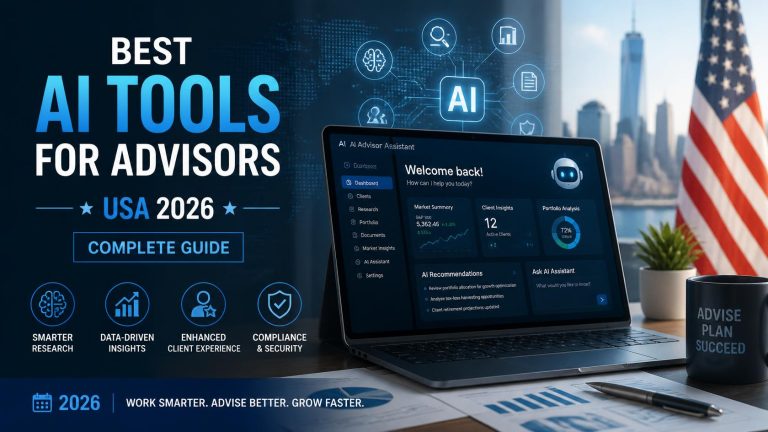
The future of AI tools is becoming a business reality in 2026. AI is moving beyond simple chatbots and text generators. Modern tools can research information, write content, analyze data, create images and video, write software, automate repetitive work, and coordinate tasks across different apps. For USA businesses, this shift creates new opportunities for small companies, creators, marketers, developers, teachers, sales teams, and large enterprises.
The biggest change is the growth of AI agents. These systems can plan a task, use connected tools, complete several steps, and report the result. McKinsey’s 2026 research shows that organizations are increasingly scaling AI agents, with larger enterprises moving faster than smaller organizations. AI adoption is also becoming more focused on measurable business value rather than experiments alone. AI Tools for Middle East Startups.
The future of AI tools will not be about replacing every worker. It will be about giving people faster ways to research, create, decide, communicate, and automate. Human judgment will remain important when work involves customers, money, legal decisions, security, brand reputation, or sensitive information.
What Is the Future of AI Tools 2026?
The future of AI tools in 2026 refers to the next stage of artificial intelligence software and services used by individuals and organizations. The focus is shifting from asking an AI model for an answer to giving AI a goal and letting it perform a useful workflow.
A traditional AI chatbot may answer, “Write a product description.” A newer AI system can research the product, study customer information, create several descriptions, prepare social media posts, organize the content, and send the finished material into another business system.
AI tools are also becoming multimodal. One platform can work with text, documents, images, audio, video, spreadsheets, and code. This reduces the need to use separate software for every creative or productivity task. The future of AI tools in education
For a USA small business, a practical AI workflow could include:
- An AI assistant researches competitors.
- A writing tool creates a first draft.
- An image tool creates marketing graphics.
- An AI spreadsheet assistant analyzes sales data.
- An automation agent updates a CRM.
- A human reviews the final work before publication.
AI Trends 2026: Key Features Shaping the Future
AI agents are one of the strongest trends in AI tools in 2026. An agent can receive a goal, break it into smaller tasks, use software tools, and complete actions with less manual prompting. McKinsey describes agents as systems that can plan, decide, and act across workflows.
A real-world example is a sales team using an AI agent to collect leads, research companies, prepare account notes, draft personalized outreach, and place the information into a CRM. The sales professional can review the work instead of starting every task from zero.

Multimodal AI Tools
Future AI tools will understand more than written prompts. Users can combine text, images, documents, voice, video, and structured data in one workflow.
A real estate agent in Florida could upload a property brochure, photos, floor plans, and market notes. An AI system could help create a listing description, social media copy, email content, and a presentation from the same information.
AI for Coding and Software Development
Coding agents are becoming a major part of software development. Developers can ask AI to understand a codebase, write functions, find bugs, create tests, and explain technical problems.
McKinsey’s 2026 State of AI research reports that many organizations are scaling software coding agents, and some companies say they have decided to build certain software features internally instead of buying them.
AI Search and Research
AI search tools are becoming more useful for research-heavy work. They can summarize multiple sources, organize findings, answer questions about documents, and create research reports. Future of AI marketing tools
A marketing manager can use AI research to study competitors, identify customer questions, collect content ideas, and prepare a campaign brief. Human review remains important because AI-generated research can contain errors or outdated information.
AI Tools Future Features Comparison
| Feature | Current AI Tools | Future-Focused AI Tools |
|---|---|---|
| Main function | Answer prompts | Complete goals and workflows |
| Input | Mostly text | Text, image, audio, video, files |
| Automation | Limited | Multi-step automation |
| Coding | Code generation | Coding agents and testing |
| Research | Summaries | Source-based research workflows |
| Business use | Individual tasks | Team and enterprise processes |
| Human role | Prompt writer | Reviewer, decision maker, strategist |
| Integration | Selected apps | Connected business systems |
Pros and Cons of AI Tools in 2026
Pros
- Faster research and content creation
- Lower time spent on repetitive work
- More accessible software development
- Faster customer support
- Better data analysis for small businesses
- More personalized marketing
- Support for creators and freelancers
- Ability to automate multi-step workflows
- Easier access to advanced capabilities without large technical teams
Cons
- AI can produce incorrect information
- Business data can create privacy and security risks
- Subscription costs can increase across teams
- Employees need training to use AI responsibly
- Poor workflows can create poor automated results
- AI-generated content may require significant human editing
- Businesses need governance for sensitive tasks
- Some advanced features depend on internet access and third-party platforms
AI Performance in 2026
AI performance is no longer measured only by how well a chatbot answers a question. Businesses also need to consider reliability, speed, integration, accuracy, automation, security, and total cost.
| AI capability | Expected 2026 direction | Useful for USA businesses |
|---|---|---|
| Writing | More context-aware | Blogs, emails, reports |
| Research | Multi-source workflows | Marketing and strategy |
| Coding | More agentic | Software teams and startups |
| Customer support | More automated | E-commerce and service companies |
| Data analysis | Easier for nontechnical users | Sales and finance |
| Image generation | Faster and more realistic | Advertising and design |
| Video generation | More practical | Social media and marketing |
| Workflow automation | More autonomous | Operations and administration |
Pricing of AI Tools in 2026
AI pricing is becoming more varied. Many platforms offer free access with limits. Individual paid plans commonly sit around the $20-per-month range, while business and enterprise plans can use per-user, usage-based, or custom pricing.
| AI tool category | Typical pricing model | Common use |
|---|---|---|
| General AI assistant | Free or monthly subscription | Writing, research, planning |
| Business AI assistant | Per-user subscription | Team productivity |
| AI coding tool | Monthly or usage-based | Software development |
| Image generator | Credits or subscription | Design and marketing |
| Video generator | Credits or subscription | Video production |
| AI automation platform | Subscription or task-based | Workflow automation |
| Enterprise AI | Custom contract | Large organizations |
Prices change frequently, so businesses should check the vendor’s current pricing page before purchasing. A 2026 pricing guide also shows that free plans remain common and that $20 monthly pricing is widespread among individual AI products.
Future of AI Tools for USA Small Businesses
Small businesses may benefit from AI because modern tools can provide capabilities that once required larger teams. A local restaurant can use AI for social media ideas, customer replies, menu descriptions, and promotional campaigns. A contractor can use AI to organize inquiries, prepare estimates, draft emails, and summarize project notes.
A small business should start with one measurable problem. Good starting points include customer support, content production, lead research, meeting summaries, data analysis, and repetitive administration.
AI and the Future of Jobs
AI is changing job tasks faster than it is creating a simple replacement story. Many jobs contain repetitive activities that can be supported by AI. Research, drafting, scheduling, documentation, coding assistance, customer service, and data analysis can all include AI-supported tasks. AI Tools for the Banking Industry in the USA.
Companies will need people who understand both business processes and AI capabilities. Human skills such as communication, judgment, creativity, leadership, relationship building, and accountability remain valuable future ai tools list
AI Risks, Security, and Human Control
The future of AI tools also requires stronger governance. AI agents may access documents, databases, email, financial systems, or customer records. A mistake can become more serious when an automated system has permission to take action.
Businesses should use clear access controls, activity monitoring, approval steps, data protection policies, and testing. Sensitive decisions should have human oversight.
IBM has highlighted governance as a major challenge as companies scale agentic AI. The message for USA businesses is practical: automation should increase control over work, not remove accountability.
Real-World Example: A USA E-Commerce Brand
Imagine a small online clothing company in Texas. The owner receives hundreds of customer questions each month. An AI assistant can categorize questions, draft responses, summarize reviews, identify repeated complaints, and help create product content.
The owner can connect the AI workflow to customer support and analytics tools. The AI handles repetitive preparation. A human approves refunds, unusual complaints, major customer issues, and important brand decisions.

FAQs About the Future of AI Tools 2026
1. What is the biggest AI trend in 2026?
AI agents and workflow automation are major trends. AI is moving from answering prompts toward completing multi-step tasks with connected software.
2. Will AI tools replace jobs in the USA?
AI can automate parts of many jobs, but the impact differs by occupation and task. Many workers are using AI as an assistant for research, writing, coding, analysis, and administration.
3. Are AI tools useful for small businesses?
Yes. Small businesses can use AI for customer support, marketing, research, content, data analysis, and repetitive administrative work. The best use case depends on the business workflow.
4. How much do AI tools cost in 2026?
Costs vary widely. Many tools have free plans, while individual subscriptions often cost around $20 per month. Business and enterprise pricing can be higher or usage-based. Most Powerful AI Tools Today
5. What should businesses check before using an AI tool?
Businesses should review accuracy, privacy, security, integrations, pricing, data handling, user permissions, and human review requirements. Testing the tool on a small workflow is a practical starting point.
Conclusion: What Wins in the Future of AI Tools?
The future of AI tools in 2026 is centered on useful automation, AI agents, multimodal systems, research, coding, personalization, and connected workflows. The strongest value will come from tools that solve measurable problems rather than tools used only because AI is popular.
For USA businesses, the practical approach is to identify repetitive work, test a suitable AI tool, measure the results, protect sensitive information, and keep humans involved in important decisions.
The future belongs to AI-assisted work where people set goals, review important results, and use intelligent software to handle repetitive steps. Businesses that understand their workflows can make better use of the expanding AI tool ecosystem.