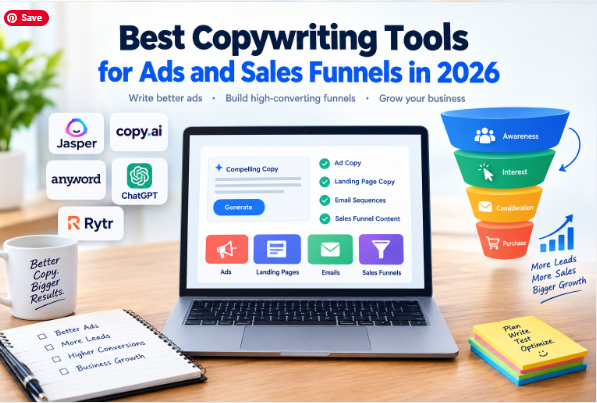
Copywriting tools help businesses create better ads, sales pages, and email campaigns without spending hours writing every line. For small businesses in the USA, strong copy can make the difference between a customer who clicks an ad and a customer who actually buys. The right copywriting tools can help you write faster, test new ideas, and explain your product’s value more clearly.
Imagine you own an online store that sells fitness products. You want to run Facebook ads, create a landing page, and send follow-up emails to people who leave products in their shopping carts. Writing everything manually takes time. AI copywriting software can help you draft different headlines, product descriptions, calls to action, and sales emails in minutes.
The challenge is choosing a tool that fits your budget and marketing goals. Some tools focus on persuasive advertising, while others are better for brand consistency, sales workflows, or quick content creation.
This guide compares popular copywriting tools for ads and sales funnels in 2026. You will learn about their features, advantages, disadvantages, pricing, and the types of businesses that can benefit from each option.
What Are Copywriting Tools for Ads and Sales Funnels?
Copywriting tools are software applications that help marketers write persuasive content designed to encourage a specific action. That action could be clicking an advertisement, joining an email list, booking a consultation, or purchasing a product.
Modern AI copywriting tools use artificial intelligence to generate, rewrite, and improve marketing messages. Users provide information about their product, audience, offer, and campaign goals. The software produces draft copy that marketers can review and refine.
A sales funnel guides potential customers from their first interaction with a business to a purchase. Copywriting supports every stage of this journey. Best AI Software Subscriptions: Pricing Guide for 2026
For example, a US-based skincare brand might use:
- Advertising copy: A Facebook ad introducing a new moisturizer.
- Landing page copy: A page explaining the product’s benefits and ingredients.
- Lead magnet copy: An offer for a free skincare guide in exchange for an email address.
- Email funnel copy: Follow-up emails sharing product information and answering common questions.
- Sales copy: A product page encouraging visitors to complete their purchase.
The best copywriting software helps businesses create consistent messages across these channels. It does not guarantee conversions. Results still depend on the offer, audience, creative quality, website experience, and campaign testing.
Best Copywriting Tools for Ads and Sales Funnels in 2026
1. Jasper AI — Best for Marketing Teams
Jasper is an AI marketing platform to businesses produce marketing content while maintaining a consistent brand voice. It is useful for teams
that manage multiple advertising campaigns and customer communication channels.
Key features:
- Brand voice and style controls.
- Marketing campaign content generation.
- Ad copy and landing page drafts.
- Reusable content workflows.
- Support for creating different versions of marketing messages.
Real-world example: A US-based digital marketing agency managing campaigns for several local businesses can use Jasper to draft Google ad headlines, promotional emails, and landing page content. Each business can have its own messaging guidelines.
Pros
- Helpful for maintaining consistent brand messaging.
- Suitable for marketing teams producing content at scale.
- Supports several types of marketing copy.
Cons
- Paid plans may be expensive for beginners.
- Generated content still needs editing.
- May offer more features than a small business requires.
Explore the official Jasper website for current features and plans.
2. Copy.ai — Best for Sales and Marketing Workflows
Copy.ai focuses on AI-assisted content creation and go-to-market workflows. It can help businesses organize repetitive writing tasks and produce messaging for different stages of the customer journey.
Key features:
- Sales and marketing content generation.
- Workflow automation capabilities.
- Product and campaign messaging.
- Email and outreach drafts.
- Reusable processes for repetitive tasks.
Real-world example: A software company in California could use Copy.ai to draft outreach emails for potential customers, create follow-up messages, and prepare product messaging for a new feature launch. Best Sales Funnel Expert
Pros
- Useful for structured sales and marketing processes.
- Can reduce repetitive writing work.
- Helps teams organize content tasks.
Cons
- Advanced workflows can require setup.
- Output needs fact-checking and personalization.
- Pricing and available features depend on the selected plan.
3. Anyword — Best for Performance-Focused Ad Copy
Anyword is designed for marketers who want to create and evaluate marketing copy using performance-oriented features. It is particularly relevant to businesses that regularly test different advertising messages.
Key features:
- Ad copy generation.
- Marketing templates.
- Brand voice features.
- Predictive performance scoring on supported plans.
- Multiple variations for testing.
Real-world example: An American ecommerce store selling running shoes could generate several ad headlines emphasizing comfort, durability, or everyday training. The marketing team can review the options, select promising versions, and test them with real customers.
Anyword’s predictive scores are estimates, not guaranteed results. Actual campaign data remains essential.
Pros
- Useful for generating multiple ad variations.
- Performance-oriented tools support campaign planning.
- Suitable for marketers who test copy frequently.
Cons
- Paid plans may not suit every small business.
- Scores cannot replace live campaign testing.
- Results depend on the quality of the input and available data.
4. ChatGPT — Best for Flexible Copywriting
ChatGPT is a flexible AI assistant that can help businesses draft advertisements, landing pages, product descriptions, email sequences, and sales scripts. Jasper vs Adobe Express: Which Tool Wins in 2026
It works well for entrepreneurs who want one tool for several marketing tasks rather than a dedicated copywriting platform.
Key features:
- Brainstorming headlines and offers.
- Writing Facebook and Google ad variations.
- Drafting landing page sections.
- Creating email follow-up sequences.
- Rewriting copy for different audiences and tones.
Real-world example: A home cleaning company in Texas could ask ChatGPT to write three Facebook ads for busy homeowners, a landing page promoting a first-time customer discount, and a follow-up email encouraging visitors to book an appointment.
Pros
- Flexible across many writing tasks.
- A free option is available.
- Easy to refine copy through follow-up prompts.
Cons
- Requires clear instructions for strong results.
- Does not guarantee higher conversion rates.
- Generated claims and details must be checked.
Try ChatGPT to explore its available features and plans.
5. Rytr — Best for Budget-Friendly Copywriting
Rytr is an AI writing tool for users who need short marketing content without a complicated workflow. It can be useful for freelancers, new businesses, and entrepreneurs who create promotional messages regularly.
Key features:
- Short-form marketing copy.
- Product descriptions.
- Social media captions.
- Email drafts.
- Rewriting and tone adjustments.
Real-world example: A small candle business in Ohio could use Rytr to create product descriptions, holiday promotion ideas, and short social media captions for its online store.
Pros
- Simple writing workflow.
- Useful for short promotional content.
- Budget-friendly options may be available.
Cons
- Advanced marketing teams may need more specialized features.
- Drafts can require substantial editing.
- Plan limits and included features should be checked before subscribing.
Copywriting Tools Comparison Table
The following table compares the tools by their main strengths. These are practical editorial assessments, not results from a controlled conversion-rate experiment.
| Tool | Best For | Main Strength | Ideal User |
|---|---|---|---|
| Jasper | Marketing campaigns | Brand consistency | Marketing teams |
| Copy.ai | Sales workflows | Repetitive task automation | Sales teams |
| Anyword | Paid advertising | Performance-oriented copy evaluation | Advertisers |
| ChatGPT | General copywriting | Flexibility | Small businesses |
| Rytr | Short marketing copy | Simplicity | Freelancers |
Key Features to Look for in AI Copywriting Software
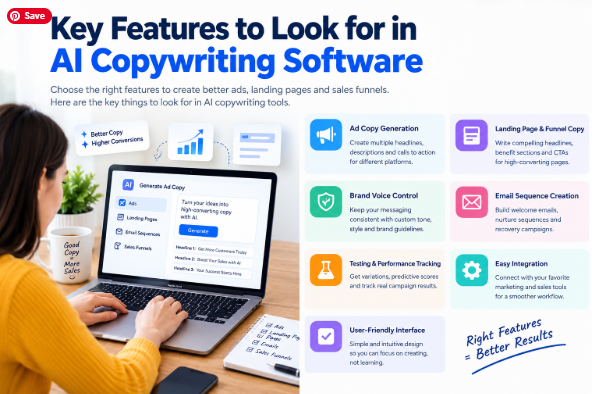
Choosing copywriting tools requires more than comparing brand names. Focus on the features that solve your current marketing problems.
1. Ad Copy Generation
Your tool should help you create multiple headlines, descriptions, and calls to action. This makes it easier to prepare variations for Google Ads, Facebook, Instagram, and other advertising channels.
For example, a local gym could test messages focused on affordable memberships, beginner-friendly workouts, or personal training.
2. Landing Page and Funnel Copy
A good tool should help you organize landing page headlines, benefit sections, customer objections, and calls to action.
A landing page promoting an online course might include a clear promise, course details, instructor information, frequently asked questions, and an enrollment button. Copywriting Meta Ads
3. Brand Voice Control
Brand voice helps your advertising sound consistent across different channels. A professional accounting firm may need a trustworthy tone, while a fashion brand may prefer a casual and energetic style.
4. Email Sequence Creation
Email sequences can welcome new subscribers, explain a product, answer common questions, and remind customers about unfinished purchases. Look for tools that help you draft connected messages rather than isolated emails. Copywriter for Ads and Emails
5. Testing and Performance Tracking
Some tools provide predictive scoring, while others help generate copy variations. You should also measure actual results through advertising and analytics platforms.
Track metrics such as:
- Click-through rate.
- Cost per lead.
- Landing page conversion rate.
- Cost per acquisition.
- Email click rate and sales.
Pros and Cons of AI Copywriting Tools
Advantages
- Save time: Generate first drafts quickly.
- Explore more ideas: Compare different headlines and offers.
- Improve consistency: Reuse brand guidelines and messaging.
- Support small teams: Produce more campaign variations with limited resources.
- Simplify repetitive work: Draft product descriptions and follow-up emails.
Disadvantages
- Generic writing: AI can produce messages that sound similar to competitors.
- Incorrect information: Product claims, statistics, and details may be inaccurate.
- Extra editing: Human review remains necessary.
- Subscription costs: Premium features can increase marketing expenses.
- Uncertain results: Better-written copy does not automatically mean more sales.
AI works best as a writing assistant, not a replacement for customer research or marketing judgment.
Copywriting Tools Performance Comparison
The following ratings are illustrative editorial scores based on the tools’ general use cases and features. They are not verified benchmark results or measured conversion rates.
| Tool | Copy Flexibility | Ad Copy Support | Team Workflows | Ease of Use |
|---|---|---|---|---|
| Jasper | 4/5 | 4/5 | 5/5 | 4/5 |
| Copy.ai | 4/5 | 4/5 | 5/5 | 4/5 |
| Anyword | 4/5 | 5/5 | 4/5 | 4/5 |
| ChatGPT | 5/5 | 4/5 | 3/5 | 5/5 |
| Rytr | 3/5 | 4/5 | 2/5 | 5/5 |
Which tool performs best? Anyword is worth considering for performance-focused advertising. Jasper is a strong option for teams that prioritize brand consistency. ChatGPT offers broad flexibility for everyday marketing copy, while Copy.ai is useful for structured workflows. Rytr is a practical starting point for simpler writing needs.
Actual performance depends on how well each tool fits your business.
Copywriting Tools Pricing Comparison in 2026
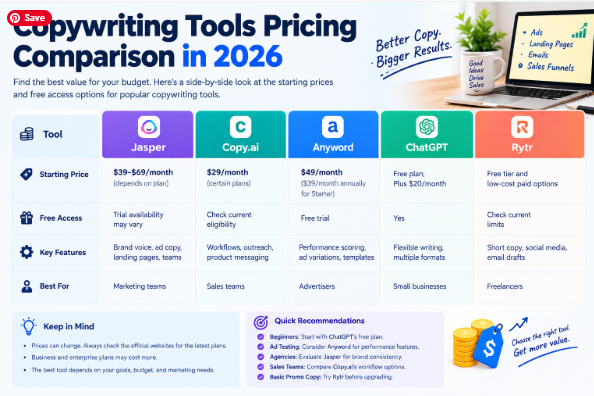
Prices and plan features can change. The following figures are indicative starting points based on publicly reported plans, not guaranteed live checkout prices. Confirm the current price, billing period, usage limits, and included features on each vendor’s website before purchasing.
| Tool | Indicative Starting Price | Free Access |
|---|---|---|
| Jasper | Around $39–$69/month, depending on plan and billing | Trial availability may vary |
| Copy.ai | Around $29/month for certain reported plans | Check current eligibility |
| Anyword | $49/month; $39/month billed annually for Starter | Free trial |
| ChatGPT | Free plan; Plus around $20/month | Yes |
| Rytr | Free tier and low-cost paid options have been offered | Check current limits |
These prices are in US dollars. Business and enterprise plans may cost more.
Which Copywriting Tool Offers the Best Value?
- For beginners: Start with ChatGPT’s free plan and test whether it meets your needs.
- For ad testing: Consider Anyword if performance-oriented features justify the subscription.
- For agencies: Evaluate Jasper if consistent brand messaging is important.
- For sales teams: Compare Copy.ai’s workflow capabilities with your existing sales process.
- For basic promotional copy: Evaluate Rytr before paying for advanced software.
Choose a paid plan only when its features solve a real business problem or save enough time to justify the cost.
How to Use Copywriting Tools in a Sales Funnel
A simple funnel can help you turn advertising attention into customer action.
Step 1: Write the ad. Ask your tool to create three versions of an ad for a specific audience, product, and offer.
Step 2: Build the landing page. Use the strongest message as the starting point for a page that explains the product’s benefits and provides a clear next step.
Step 3: Capture leads. Offer something relevant, such as a checklist, sample, consultation, or discount, in exchange for contact details.
Step 4: Write follow-up emails. Create a welcome email, an educational message, and a relevant offer. Avoid sending unnecessary or misleading messages.
Step 5: Measure the results. Compare clicks, leads, purchases, and acquisition costs. Keep the messages that work and revise the weaker ones.
For additional ideas, explore our AI writing tools guide and visit Google Analytics to learn about website measurement.
FAQs About Copywriting Tools
1. What are the best copywriting tools for ads and sales funnels?
ChatGPT is a flexible starting point for general copywriting. Anyword is worth evaluating for performance-focused advertising, Jasper for brand consistency, Copy.ai for structured sales workflows, and Rytr for simpler promotional writing.
2. Can AI copywriting tools increase sales?
They can help you create and test marketing messages more efficiently. Increased sales are not guaranteed. Results depend on your product, audience, offer, pricing, website, and campaign execution.
3. Are free copywriting tools good enough for small businesses?
Yes. Free tools can be enough for writing basic ads, product descriptions, and email drafts. Paid plans become more useful when you need advanced brand controls, collaboration, larger usage limits, or specialized features.
4. Which copywriting tool is best for Facebook and Google Ads?
Anyword is worth considering if you want performance-oriented copy evaluation. ChatGPT can generate multiple ad variations, and Jasper can help teams maintain a consistent marketing voice. Test the final copy against real campaign results.
5. Do I need a separate tool for sales funnels?
Not always. A general-purpose assistant can draft ads, landing pages, and email sequences. A dedicated platform may be useful when you need reusable workflows, team collaboration, brand controls, or campaign-specific features.
Conclusion:
The best copywriting tools for ads and sales funnels depend on your goals, budget, and marketing experience.
ChatGPT is the best starting point for many small businesses because it supports a wide range of writing tasks and offers free access. Anyword is a strong candidate for advertisers who want performance-oriented features. Jasper suits teams that need consistent brand messaging, Copy.ai fits structured sales workflows, and Rytr can help with straightforward promotional copy. Copywriting Ad Copy
Start with one tool, write a real campaign, and test its results. Focus on leads, sales, and customer response rather than the number of words generated. The right tool is the one that helps your business communicate clearly and make better marketing decisions.