AI tools for financial advisors are changing how financial professionals manage client relationships, analyze financial documents, prepare reports, and deliver personalized services. Financial advisors in the USA face growing workloads, ai tools for investment advisors rising client expectations, and strict regulatory responsibilities. Manual data entry, meeting notes, and repetitive administrative tasks can take valuable time away from clients.
Artificial intelligence offers practical solutions. Advisors can use specialized AI assistants to summarize meetings, organize client information, review tax documents, and improve financial planning workflows. Tools such as Jump, Zocks, RightCapital, and Holistiplan serve different needs within modern advisory practices. AI SaaS Tools for Startups USA: Best Picks in 2026
Imagine an independent financial advisor in Texas who spends several hours each week preparing client meeting summaries. An AI meeting assistant can generate draft notes and follow-up tasks, allowing the advisor to focus more on retirement goals and investment discussions.
AI does not replace professional judgment. Financial recommendations require appropriate verification, accurate client information, and compliance with applicable regulations. Copywriting Tools for Ads and Sales Funnels
What Are AI Tools for Financial Advisors?
AI tools for financial advisors are software applications that use artificial intelligence to support financial planning, client communication, research, documentation, and business operations.
These tools may use machine learning, natural language processing, document recognition, and generative AI to organize information and automate repetitive tasks.
Financial advisors can use AI to:
- Summarize client meetings and create follow-up tasks.
- Analyze tax returns and financial documents.
- Prepare draft client communications.
- Organize customer relationship management (CRM) records.
- Research financial topics and summarize reports.
- Support retirement planning and risk discussions.
- Create marketing content and educational materials.
For example, a retirement advisor in Florida could use financial planning software to model retirement scenarios and prepare a draft explanation of projected expenses. The advisor must verify the calculations, assumptions, and suitability of the final recommendations.
Best AI Tools for Financial Advisors in 2026
1. Jump — Best for AI Meeting Assistance
Jump is an AI assistant designed for financial advisory workflows. It helps advisors prepare for meetings, create summaries, draft follow-up communications, and transfer relevant information into supported CRM systems ai tools for financial planners
Key features
- AI-generated meeting summaries.
- Follow-up emails and action items.
- Meeting preparation assistance.
- Integrations with supported advisor CRMs.
- Automated documentation workflows.
Real-world example: An advisor in California finishes a retirement planning meeting. Jump can prepare a draft summary of the client’s goals and identify follow-up tasks for the advisor to review.
Pros
- Designed around financial advisory workflows.
- Reduces repetitive documentation.
- Supports connected CRM processes.
Cons
- Paid plans may be expensive for solo advisors.
- Integration and compliance features depend on the selected plan.
Best for advisors who spend significant time documenting client conversations.
Official website: https://jump.ai/
2. Zocks — Best for Advisor-Focused AI Workflows
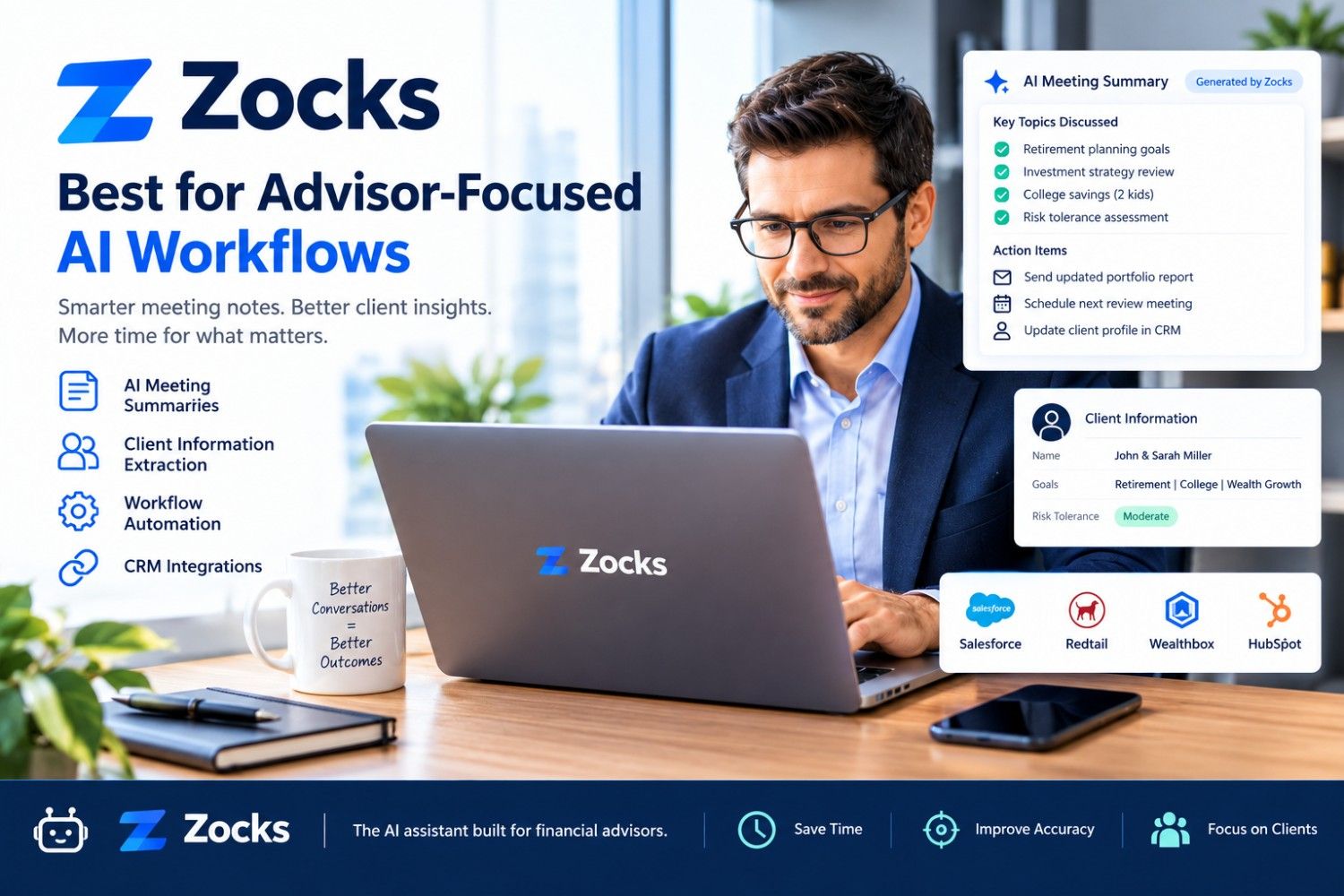
Zocks provides AI assistance for financial advisors, including meeting documentation, structured client information, and workflow automation.
Key features
- Meeting summaries and structured notes.
- Client information extraction.
- Automated forms and workflow support.
- Advisor-focused organization of meeting information.
Real-world example: A wealth manager in New York can use Zocks to turn a client discussion about college savings, retirement, and risk tolerance into organized notes for review.
Pros
- Built for financial advisory use cases.
- Helps organize client conversations.
- Supports administrative efficiency.
Cons
- Pricing can be significant for larger teams.
- Advisors must review generated notes and confirm integration compatibility.
Best for advisory firms seeking specialized meeting intelligence.
Official website: https://www.zocks.io/
3. RightCapital — Best for Financial Planning
RightCapital is financial planning software that helps advisors develop and evaluate plans for retirement, cash flow, taxes, and other financial goals. Its AI-related capabilities can support planning workflows, depending on the subscription tier.
Key features
- Retirement planning scenarios.
- Cash-flow analysis.
- Tax-aware financial planning.
- Client-facing planning visualizations.
- AI-assisted planning capabilities on eligible plans.
Real-world example: An advisor working with a couple approaching retirement can model different retirement dates and spending assumptions. The resulting scenarios help the advisor explain possible outcomes.
Pros
- Planning-focused functionality.
- Supports visual financial discussions.
- Useful for personalized retirement scenarios.
Cons
- Subscription costs may be high for new practices.
- Results depend on the accuracy of client data and assumptions.
Best for advisors who prioritize comprehensive financial planning.
Official website: https://www.rightcapital.com/
4. Holistiplan — Best for Tax Planning
Holistiplan uses document-processing technology to help financial advisors review tax returns and identify potential planning opportunities.
Key features
- Tax document extraction.
- Organized tax information.
- Identification of potential planning questions.
- Support for tax-focused client conversations.
Real-world example: A financial advisor receives a client’s tax return before an annual review. Holistiplan can help identify information worth examining, such as income, deductions, and possible tax-planning considerations.
Pros
- Designed for tax-focused advisory workflows.
- Reduces some manual document review.
- Helps prepare more focused client discussions.
Cons
- Does not replace a qualified tax professional.
- Advanced capabilities may require higher-priced plans.
Best for advisors who incorporate tax planning into financial reviews.
Official website: https://www.holistiplan.com/
5. FP Alpha — Best for Advanced Planning Documents
FP Alpha helps advisors analyze documents connected to tax, estate, and insurance planning. Its AI-powered capabilities can help surface information that deserves further professional review.
Key features
- Tax document analysis.
- Estate planning document review.
- Insurance-related insights.
- Identification of potential planning opportunities.
Real-world example: An advisor working with a business owner can use document analysis to prepare questions about estate arrangements, insurance coverage, and tax considerations before a planning meeting.
Pros
- Supports multiple advanced planning areas.
- Helps organize complex documents.
- Useful for comprehensive client reviews.
Cons
- Additional software may increase operating costs.
- Extracted information and suggested opportunities require verification.
Best for firms offering advanced tax, estate, and insurance planning.
Official website: https://fpalpha.com/
6. Wealthbox — Best for AI-Enabled CRM Workflows
Wealthbox is a CRM platform built for financial advisors. Its AI-related capabilities and available add-ons can help with meeting notes, client records, and workflow management.
Key features
- Client relationship management.
- Task and workflow organization.
- Meeting documentation options.
- Contact history and team collaboration.
Real-world example: An advisor in Chicago can organize client follow-ups after annual reviews and keep important planning discussions connected to the appropriate client record.
Pros
- Financial advisor-focused CRM.
- Helps organize client relationships.
- Supports structured team workflows.
Cons
- Some AI capabilities cost extra.
- The value depends on existing software and integration needs.
Best for advisors who want client management and workflow organization in one system.
Official website: https://www.wealthbox.com/
AI Financial Advisor Tools: Features Comparison Table
| AI Tool | Best For | Main Features | Ideal User |
|---|---|---|---|
| Jump | Meeting assistance | Notes, follow-ups, CRM workflows | Busy advisors |
| Zocks | Advisor AI assistant | Meeting summaries, client information | Small and growing RIAs |
| RightCapital | Financial planning | Retirement and cash-flow scenarios | Financial planners |
| Holistiplan | Tax planning | Tax return analysis | Tax-focused advisors |
| FP Alpha | Advanced planning | Estate, tax, and insurance documents | Comprehensive planning firms |
| Wealthbox | Client management | CRM, tasks, workflow organization | Independent advisors |
The right choice depends on the task that consumes the most time. Meeting documentation points toward Jump or Zocks. Retirement modeling favors RightCapital. Tax-focused practices may benefit from Holistiplan, while advanced planning firms can evaluate FP Alpha.
Pros and Cons of AI Tools for Financial Advisors
Benefits of AI Financial Advisor Software
- Time savings: Automate portions of meeting documentation and repetitive administration.
- Better organization: Keep client information, tasks, and notes structured.
- Improved preparation: Identify important questions before client meetings.
- Scalable service: Support growing client lists without increasing every administrative task.
- Consistent workflows: Use templates and repeatable processes for common activities.
- Research support: Summarize lengthy documents and organize background information.
Limitations of AI Financial Advisor Tools
- Privacy risks: Client financial information requires careful handling.
- Incorrect outputs: AI may misinterpret figures or generate unsupported statements.
- Compliance responsibilities: Software does not automatically make an advisory practice compliant.
- Subscription expenses: Multiple tools can increase monthly operating costs.
- Integration limitations: Some platforms work only with supported systems or specific subscription tiers.
- Human oversight: Advisors remain responsible for reviewing work and making appropriate recommendations.
AI is most useful when it supports a defined workflow and leaves important decisions under professional control.
Performance Comparison: AI Tools for Financial Advisors
The following ratings are qualitative editorial assessments of each tool’s primary use case, not results from a controlled performance test.
| Tool | Meeting Support | Planning Support | Document Analysis | Overall Fit |
|---|---|---|---|---|
| Jump | Excellent | Limited | Moderate | Strong for documentation |
| Zocks | Excellent | Moderate | Moderate | Strong for advisor workflows |
| RightCapital | Moderate | Excellent | Good | Strong for financial planning |
| Holistiplan | Limited | Good | Excellent for tax documents | Strong for tax analysis |
| FP Alpha | Limited | Good | Excellent for advanced planning | Strong for document-heavy planning |
| Wealthbox | Good with relevant features | Limited | Moderate | Strong for CRM workflows |
An advisor should test software with realistic but appropriately protected sample data before making a purchasing decision. Evaluate accuracy, ease of use, integration quality, auditability, and time saved.
Pricing Table: AI Tools for Financial Advisors USA
Prices and packages can change. Some providers require demonstrations or customized quotes. Verify current rates with the vendor before purchasing.
| Tool | Pricing Approach | Budget Consideration |
|---|---|---|
| Jump | Paid subscription; modules may cost extra | Higher per-advisor expense |
| Zocks | Tiered subscription | Compare annual and monthly billing |
| RightCapital | Tiered advisor subscription | Premium planning capabilities may cost more |
| Holistiplan | Annual subscription | Check household and feature limits |
| FP Alpha | Annual or customized packages | Review document and usage allowances |
| Wealthbox | Per-user CRM plans; AI add-ons may be extra | Calculate the full cost per user |
How Much Should a Financial Advisor Budget?
A solo advisor should calculate the complete cost of the software stack, not just the entry-level price.
Consider these expenses:
- CRM subscriptions.
- Meeting assistants.
- Financial planning software.
- Tax and estate analysis tools.
- Compliance archiving and security services.
- Staff training and implementation.
For example, a small advisory firm might start with one CRM and one meeting assistant. It could add tax analysis software when client demand justifies the additional expense. This approach avoids paying for overlapping features in AI prospecting tools for financial advisors
Compliance and Security: What USA Advisors Should Check
Financial advisors should evaluate AI tools against their firm’s legal, regulatory, contractual, and security obligations.
Important checks include:
- SEC requirements: Registered investment advisers should assess applicable books-and-records obligations, including Rule 204-2 where relevant.
- Privacy safeguards: Review access controls, encryption, data retention, deletion policies, and vendor data use.
- Client consent: Follow applicable requirements and firm policies before recording or processing client conversations.
- Human review: Check AI-generated notes, financial figures, research, and client communications.
- Recordkeeping: Confirm that relevant records can be retained and retrieved under the firm’s procedures.
- Vendor oversight: Review contracts, security documentation, incident response, and integration permissions.
An AI tool’s marketing claims are not proof that every use is compliant. Advisors should consult their compliance professionals before introducing AI into regulated workflows. Best AI Image Generators in the USA.

FAQs About AI Tools for Financial Advisors
1. What are the best AI tools for financial advisors in 2026?
Jump and Zocks are strong options for meeting documentation. RightCapital supports financial planning, Holistiplan focuses on tax analysis, FP Alpha supports advanced planning, and Wealthbox organizes client relationships.
2. Can AI replace financial advisors?
No. AI can assist with documentation, research, and administrative tasks, but human advisors remain important for professional judgment, personalized guidance, client relationships, and appropriate oversight.
3. Are AI tools for financial advisors secure?
Security varies by provider and subscription. Review data protection, encryption, retention, access controls, and vendor policies. Avoid entering sensitive client information into tools that your firm has not approved.
4. What is the cheapest AI tool for financial advisors?
There is no single cheapest option for every task. General-purpose assistants may offer free or lower-cost plans, while specialized advisory platforms usually require paid subscriptions. Compare total costs and security requirements before choosing.
5. How can financial advisors use AI to save time?
Advisors can use AI to draft meeting summaries, organize follow-up tasks, extract information from documents, prepare client communications, and support financial planning workflows. Every important output should be reviewed before use.
Conclusion: Which AI Tool Wins in 2026?
The best AI tools for financial advisors depend on the needs of the practice. Jump and Zocks are strong candidates for meeting documentation and client workflow automation. RightCapital is a practical choice for financial planning, Holistiplan supports tax-focused reviews, FP Alpha helps with advanced planning documents, and Wealthbox provides client relationship management.
Our overall recommendation: Start with the workflow that consumes the most staff time. Choose one suitable tool, test it with approved data, measure the time saved, and confirm that its security and recordkeeping features meet your firm’s requirements.
AI should help financial advisors deliver more organized, responsive service without replacing professional judgment. The winning tool is the one that improves daily work, protects client information, and fits the firm’s budget and compliance framework.