Best AI Tools for Small Business can help U.S. entrepreneurs save time, reduce repetitive work, improve marketing, manage customers, and make better business decisions. A small company does not always have the budget to hire a full marketing team, sales team, designer, bookkeeper, and automation specialist. AI can fill some of those gaps.
A local restaurant can use AI to create social media captions and promotional emails. A real estate agent can use AI to summarize client conversations and prepare property descriptions. An online store can automate customer messages, product content, and repetitive administrative tasks
The best solution depends on the business. Some companies need writing and research. Others need accounting, CRM software, graphic design, or workflow automation OpenAI / ChatGPT Business
This guide compares popular AI tools for small businesses in the USA and explains where each one fits.
What Are AI Tools for Small Business?
AI tools for small business are software applications that use artificial intelligence to help owners and employees complete business tasks faster or with less manual work.
Common uses include:
- Content and blog writing
Email marketing
- Customer relationship management
- Graphic design
- Bookkeeping and financial analysis
- Customer support
- Meeting summaries
- Workflow automation
- Sales research
- Data analysis
- Social media management
- Business planning
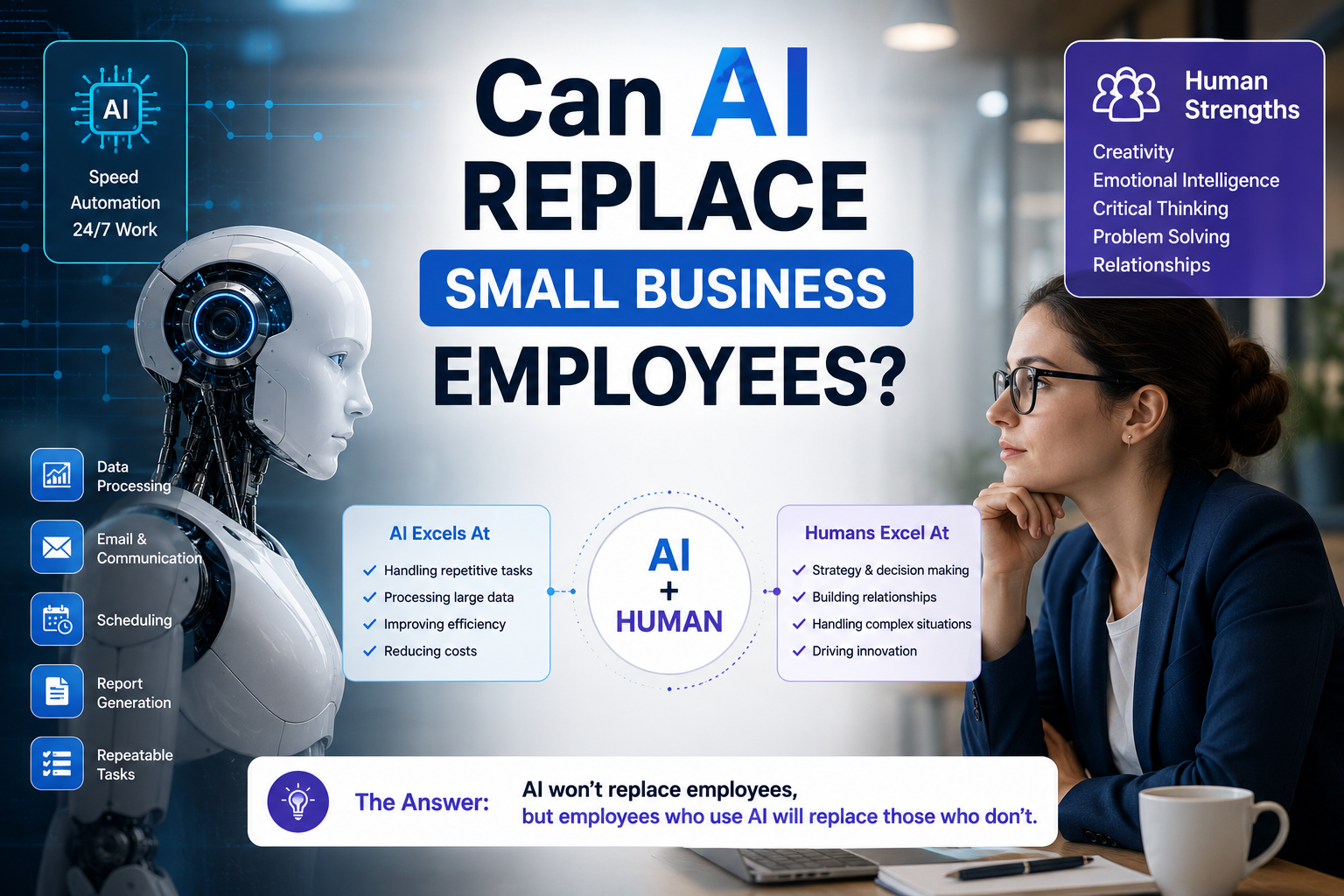
AI does not automatically replace employees. Its biggest value for many small companies is reducing repetitive work so people can focus on customers, sales, strategy, and operations.
For example, a five-person marketing agency can use AI to create first drafts, summarize meetings, organize information, and automate lead follow-ups. Employees still review the final work.
Best AI Tools for Small Business USA: Comparison Table
| AI Tool | Best For | Key Strength | Starting Price* |
|---|---|---|---|
| ChatGPT | Writing, research, analysis | Versatile AI assistant | Free; Business from $20/user/mo annually |
| HubSpot | CRM and marketing | Customer management + AI | Free; Starter from $7/seat/mo |
| Canva | Design and marketing | AI-assisted visual content | Free; paid plans available |
| Zapier | Automation | Connects business apps | Free; Professional from $19.99/mo |
| QuickBooks Online | Accounting | AI-powered bookkeeping | $38/mo list price |
| Claude | Writing and analysis | Long-form reasoning and documents | Free; paid plans available |
| Microsoft Copilot | Microsoft workflows | Office and business productivity | Plan dependent |
*Prices vary by plan, billing cycle, usage, promotions, and region.
ChatGPT — Best Overall AI Tool for Small Business
ChatGPT is one of the most flexible choices for a small company. It can help with customer emails, marketing ideas, business plans, research, spreadsheets, summaries, brainstorming, documentation, and many other tasks.
For teams, ChatGPT Business provides a shared workspace, centralized billing, administration controls, integrations, and business-focused privacy features. OpenAI currently lists Standard Business seats at $25 per user monthly or $20 per user monthly when billed annually. A Business workspace requires at least two seats.
Best uses:
- Writing website content
- Creating email campaigns
- Researching competitors
- Drafting proposals
- Summarizing documents
- Creating customer-service responses
- Analyzing business information
- Brainstorming product ideas
Real-world example: A U.S. landscaping company can use ChatGPT to create seasonal email campaigns, FAQ content, service descriptions, and first drafts of customer responses.
Pros:
- Extremely versatile
- Easy to use
- Useful across many departments
- Strong writing and analysis capabilities
- Business workspace available
Cons:
- Human review remains important
- Incorrect information can occur
- Advanced business features require paid plans
HubSpot — Best AI CRM for Small Businesses
HubSpot is a strong option for companies focused on leads, sales, customer relationships, and marketing. Its free CRM includes contact management, deal pipelines, CRM imports, reporting, and AI features such as Breeze Assistant. HubSpot’s current free tools support up to two users, while its Starter Customer Platform begins at $7 per seat per month under the displayed offer.
Best uses:
- Managing leads
- Tracking sales opportunities
- Customer communication
- Marketing campaigns
- Sales automation
- Customer service
Pros:
- Free entry-level CRM
- Strong marketing ecosystem
- Customer information stays organized
- AI features are built into the platform
Cons:
- Advanced features can become expensive
- Some AI features use credits
- Large businesses may need higher-tier plans
Real-world example: A small home-remodeling company can record leads, track estimates, schedule follow-ups, and organize customer conversations from one CRM.
Canva — Best AI Design Tool for Small Business Marketing
Canva is useful for small businesses that need professional-looking visuals without hiring a full-time graphic designer. Business owners can create social media graphics, flyers, presentations, advertisements, posters, brochures, and other marketing materials
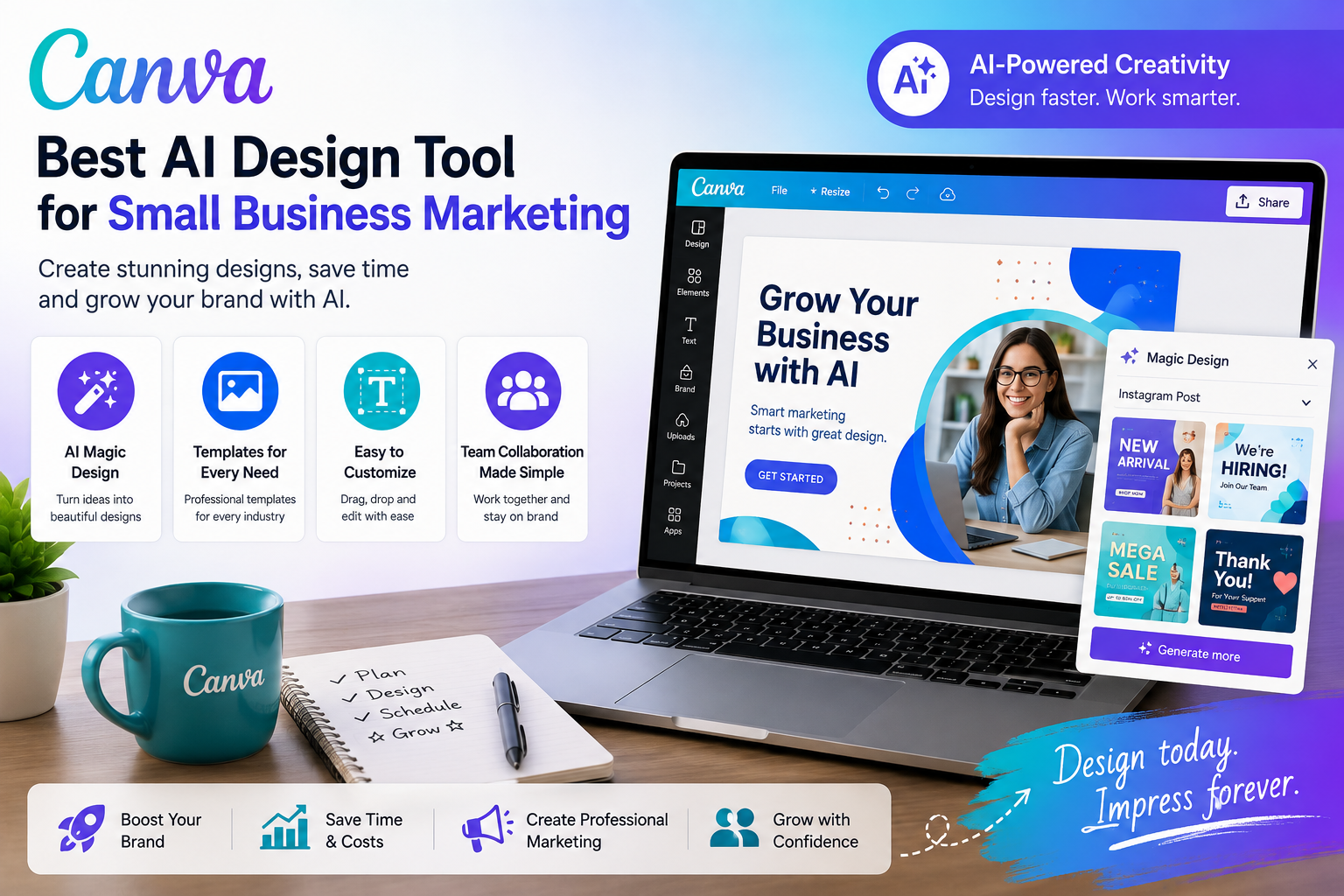
AI-assisted features can speed up content creation and help turn basic ideas into marketing assets.
Best uses:
- Social media posts
- Facebook and Instagram graphics
- Presentations
- Flyers
- Business brochures
- Advertisements
- Brand assets
Pros:
- Beginner-friendly
- Large design ecosystem
- Fast content creation
- Useful templates
- Suitable for marketing teams
Cons:
- Advanced features require paid plans
- Templates can look repetitive
- Professional branding still needs human direction
Canva has also changed its team pricing structure. Its current standard team pricing has been reported at $10 per person per month starting at three people, while some legacy customers retain older pricing arrangements.
Zapier — Best AI Automation Software for Small Business
Zapier is designed to connect applications and automate repetitive workflows. It can move information between tools and trigger actions without requiring traditional programming.
Its current Free plan includes 100 tasks per month. Professional starts at $19.99 per month, while Team starts at $69 per month. Zapier also now includes AI-oriented workflow capabilities.
Best uses:
- Lead notifications
- Form automation
- Email workflows
- CRM updates
- Data transfer
- Task creation
- AI-assisted workflows
Real-world example: A dental marketing company can create a workflow where a website form submission creates a CRM contact, alerts a salesperson, adds a follow-up task, and sends a confirmation email.
Pros:
- Many integrations
- No-code automation
- Saves repetitive manual work
- Useful for growing businesses
Cons:
- Task limits matter
- Complex workflows require planning
- Costs can increase with usage
QuickBooks Online — Best AI Accounting Tool for Small Business
QuickBooks Online is designed for accounting, invoicing, expenses, payments, reports, and financial management. Its current plans include AI-related features such as automated expense categorization, AI Chat, accounting assistance, tax deduction tools, and financial insights depending on the plan.
The current listed price for Simple Start is $38 per month before the displayed promotional discount. Essentials is listed at $75, Plus at $115, and Advanced at $275 per month before the displayed discount.
Best uses:
- Bookkeeping
- Invoicing
- Expense tracking
- Financial reports
- Cash-flow analysis
- Tax-related organization
Pros:
- Designed for business accounting
- AI features can reduce manual bookkeeping
- Strong financial reporting
- Useful for U.S. businesses
Cons:
- More expensive than basic AI writing tools
- Accounting still requires oversight
- Advanced functions cost more
Claude — Best AI for Writing and Document Analysis
Claude is another strong AI assistant for small businesses. It can help with writing, document analysis, brainstorming, summaries, research, and business communication.
It can be particularly useful for companies that frequently work with long documents, policies, proposals, reports, or internal knowledge.
Best uses:
- Business writing
- Document analysis
- Reports
- Research
- Brainstorming
- Customer communication
Pros:
- Strong writing quality
- Useful for lengthy documents
- Simple interface
- Good brainstorming capabilities
Cons:
- Some advanced capabilities require paid plans
- AI-generated information still needs review
- Business value depends on workflow integration
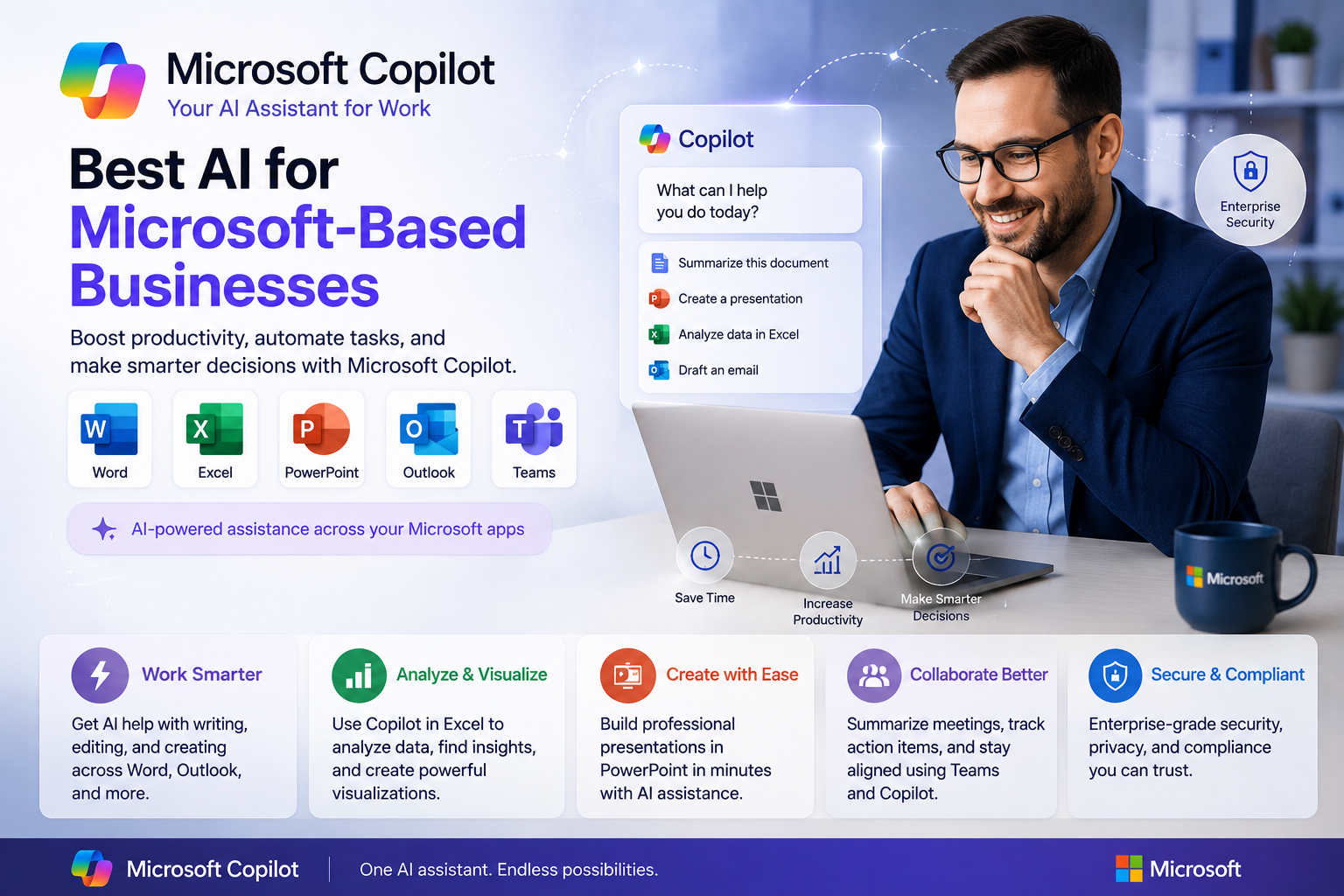
Microsoft Copilot — Best AI for Microsoft-Based Businesses
Businesses already using Microsoft products may benefit from Microsoft Copilot. It can fit naturally into workflows involving documents, spreadsheets, presentations, email, meetings, and other Microsoft services.
Best uses:
- Microsoft 365 productivity
- Email assistance
- Document creation
- Spreadsheet analysis
- Meeting productivity
- Presentations
Pros:
- Strong Microsoft ecosystem integration
- Useful for office productivity
- Familiar environment for Microsoft users
Cons:
- Pricing depends on the Microsoft plan
- Best value often comes from existing Microsoft users
- Advanced business features can require specific licenses
AI Business Software Performance Comparison
| Tool | Ease of Use | Automation | Marketing | Finance | CRM | Overall |
|---|---|---|---|---|---|---|
| ChatGPT | 5/5 | 4/5 | 5/5 | 3/5 | 3/5 | 5/5 |
| HubSpot | 4/5 | 5/5 | 5/5 | 2/5 | 5/5 | 5/5 |
| Canva | 5/5 | 3/5 | 5/5 | 1/5 | 2/5 | 4.5/5 |
| Zapier | 4/5 | 5/5 | 4/5 | 3/5 | 4/5 | 4.5/5 |
| QuickBooks | 4/5 | 4/5 | 2/5 | 5/5 | 3/5 | 4.5/5 |
| Claude | 5/5 | 3/5 | 4/5 | 3/5 | 2/5 | 4/5 |
| Microsoft Copilot | 4/5 | 4/5 | 4/5 | 4/5 | 3/5 | 4/5 |
Note: Scores are editorial comparisons based on typical small-business use cases, not independent benchmark measurements.
AI Tools for Small Business Pricing Comparison
| Tool | Free Option | Paid Starting Point | Best Value For |
|---|---|---|---|
| ChatGPT | Yes | $20/user/mo annually for Business | General productivity |
| HubSpot | Yes | $7/seat/mo Starter offer | CRM and marketing |
| Canva | Yes | Paid plans vary | Visual marketing |
| Zapier | Yes | $19.99/mo Professional | Automation |
| QuickBooks | Trial/promotions vary | $38/mo list price | Accounting |
| Claude | Yes | Paid plans vary | Writing and analysis |
| Microsoft Copilot | Plan dependent | Plan dependent | Microsoft users |
ChatGPT Business pricing is currently $20 per Standard seat per month with annual billing or $25 with monthly billing. HubSpot lists Free tools at $0 and its Starter Customer Platform from $7 per seat per month under its current pricing display. Zapier lists Professional from $19.99 per month. QuickBooks currently lists Simple Start at $38 per month before its displayed promotion.
How Small Businesses Can Use AI in the USA
A small business does not need ten AI subscriptions on day one.
Start with the biggest time-consuming problem HubSpot pricing
marketing:
- ChatGPT for content ideas and copy
- Canva for visual content
- HubSpot for leads and campaigns
sales:
- HubSpot for CRM
- ChatGPT for proposals and email drafts
- Zapier for lead automation
accounting:
- QuickBooks Online for bookkeeping
- AI tools for financial summaries and organization
operations:
- Zapier for repetitive workflows
- ChatGPT for documentation and process creation
- Microsoft Copilot for Microsoft-based teams
A practical AI stack might include ChatGPT + Canva + HubSpot. A more automation-heavy company could add Zapier. A business that needs accounting software can add QuickBooks Online.
Pros and Cons of AI for Small Businesses
Pros
- Saves employee time
- Reduces repetitive tasks
- Supports marketing
- Improves response speed
- Helps small teams produce more content
- Can reduce some operational costs
- Provides affordable access to advanced software
Cons
- AI output can contain errors
- Subscription costs can add up
- Employees need training
- Sensitive information requires careful handling
- Poor automation can create new problems
- Human review remains important
Small businesses should establish basic AI policies before employees enter confidential customer, financial, legal, or employee information into third-party systems.
FAQs About AI Tools for Small Business
1. What is the best AI tool for a small business?
ChatGPT is the strongest overall choice for many small businesses because it can support writing, research, analysis, brainstorming, documentation, and other daily tasks. A specialized tool can be better for accounting, CRM, design, or automation.
2. Are AI tools affordable for small businesses?
Yes. Several platforms offer free plans or relatively low-cost entry plans. HubSpot and Zapier both offer free starting options, while ChatGPT also provides a free version. Paid plans become useful when a company needs more users, automation, capacity, or business controls.
3. Can AI replace small business employees?
AI can automate specific tasks, but it does not automatically replace an entire employee or department. Human judgment is still important for customer relationships, strategy, financial decisions, quality control, and sensitive business decisions.
4. Which AI tool is best for small business marketing?
Canva is excellent for visual marketing, ChatGPT is useful for copy and ideas, and HubSpot is stronger for managing leads and marketing workflows. Using these tools together can create a more complete marketing system.
5. How should a small business start using AI?
Choose one repetitive task first. Measure the time currently spent on that task. Test one AI tool. Create a review process. Measure the results after several weeks. Expand only when the tool provides a clear business benefit.
Conclusion: Which AI Tool Wins for Small Business?
The best AI tools for small business depend on the company’s biggest challenge.
ChatGPT wins overall because it can support many business functions from one platform. It is particularly useful for owners and small teams that need writing, research, analysis, planning, and productivity support.
HubSpot wins for CRM and marketing. It is a strong choice for companies that need organized lead and customer management.
Canva wins for visual marketing. It helps small businesses produce professional graphics without advanced design skills Canva
Zapier wins for automation. It is ideal for companies that spend too much time moving information between apps.
QuickBooks Online wins for AI-supported accounting. It is the strongest choice in this list for bookkeeping and financial management.
A smart U.S. small-business strategy is not to buy every AI product. Choose the tool that solves the most expensive or time-consuming problem first. Track the results. Build a small AI workflow around proven use cases.
The right AI stack can help a small business compete with larger companies while keeping its team focused on customers, revenue, and growth AI Tool For Law Firms USA .