
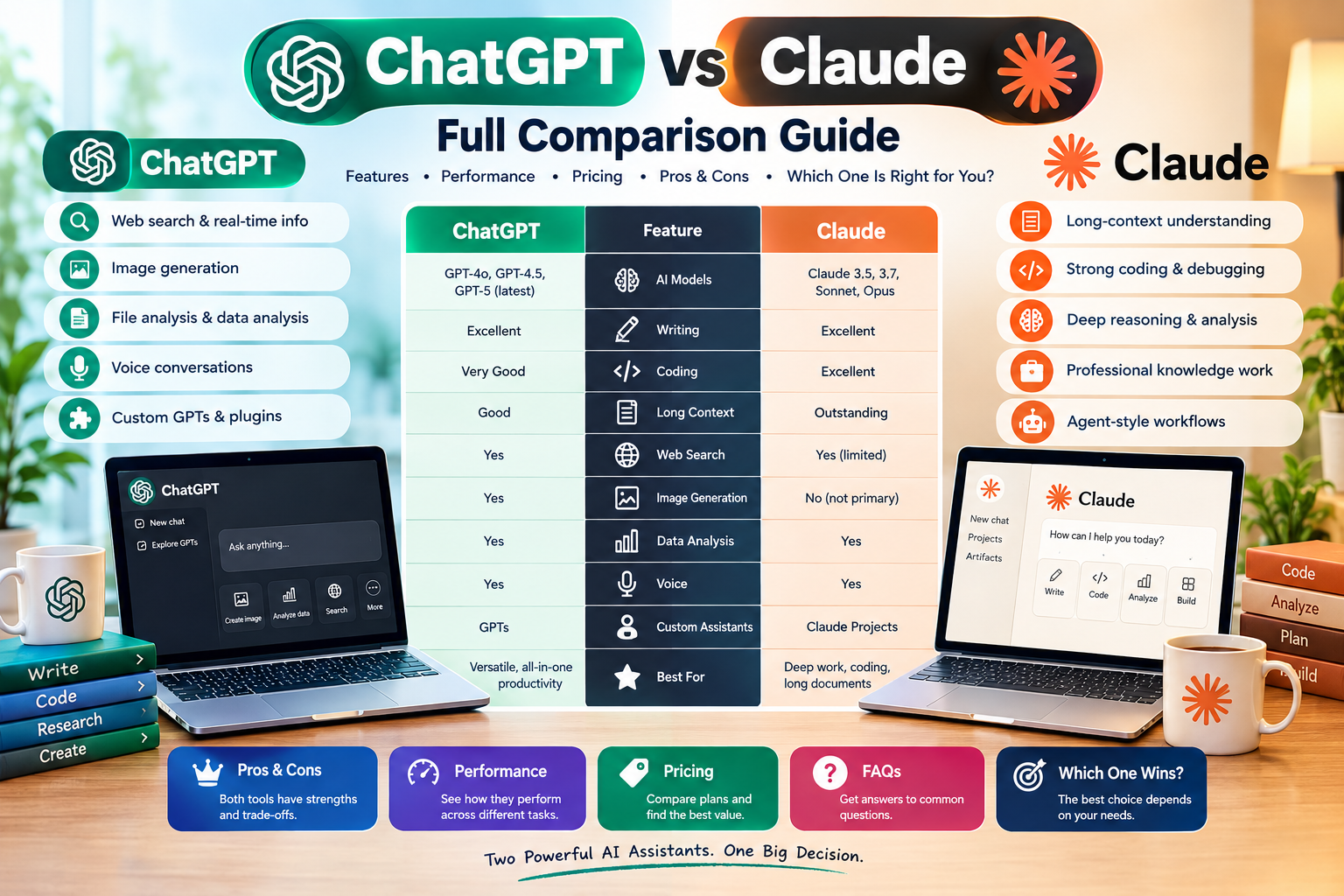
ChatGPT vs Claude is one of the most searched AI comparison topics for people who want a reliable AI assistant for work, school, coding, writing, research, and business. Both platforms can generate text, analyze information, help with complex tasks, and support professional workflows. Their features, model options, interfaces, pricing, and strengths are different.
ChatGPT is developed by OpenAI. Claude is developed by Anthropic. ChatGPT offers a broad collection of tools including web search, image generation, file analysis, voice, data analysis, and custom GPTs. Claude focuses heavily on long-context work, coding, reasoning, professional knowledge work, and agent-style workflows. OpenAI says ChatGPT can search the web, analyze files, create images, and support everyday tasks. Anthropic describes its current Claude models as supporting coding, agents, long-context reasoning, and professional work ChatGPT vs Gemini – Which is Better in 2026.
The right choice depends on what you actually need from an AI assistant.
What Is ChatGPT vs Claude?
ChatGPT and Claude are AI assistants that use large language models to understand prompts and generate responses.
What Is ChatGPT?
ChatGPT is OpenAI’s AI assistant. It can help with:
- Blog writing
- Research
- Coding
- Data analysis
- Image creation
- File analysis
- Brainstorming
- Learning
- Planning
- Voice conversations
- Web search
OpenAI’s current ChatGPT experience includes multiple model and reasoning options depending on the user’s plan. Paid plans provide broader access to models and tools.
For example, a US small-business owner can use ChatGPT to create a marketing plan, analyze a spreadsheet, generate an image concept, research a topic, and turn the research into a blog post.
What Is Claude?
Claude is Anthropic’s AI assistant. Claude is designed for conversations, writing, coding, analysis, long documents, and complex professional workflows.
Anthropic’s current Claude Sonnet models include long-context capabilities, while higher Claude models target complex coding, agentic work, and professional tasks. Anthropic currently lists Claude Opus 5.5 as a high-end model for complex coding and AI-agent workloads.
A developer, for example, can provide a large amount of project information and ask Claude to analyze requirements, explain code, identify issues, or help plan changes.
ChatGPT vs Claude Features Comparison
The biggest difference is not simply intelligence. The products are built around different combinations of models, tools, interfaces, and workflows.
| Feature | ChatGPT | Claude |
|---|---|---|
| AI chat | Yes | Yes |
| Writing | Strong | Strong |
| Coding | Strong | Strong |
| Long documents | Yes | Strong long-context support |
| Web search | Yes | Available through Claude features |
| Image generation | Yes | Not a primary Claude feature |
| File analysis | Yes | Yes |
| Data analysis | Yes | Yes |
| Voice | Yes | Available |
| AI agents | Yes | Yes |
| Custom assistants | Custom GPTs | Claude projects/features |
| Business plans | Yes | Yes |
| API access | Yes | Yes |
ChatGPT’s current Plus plan includes advanced reasoning, voice conversations, image generation, file uploads and analysis, and Deep Research where available. Claude’s current model lineup includes models designed for coding, agents, long-context reasoning, and professional work.
ChatGPT vs Claude for Writing
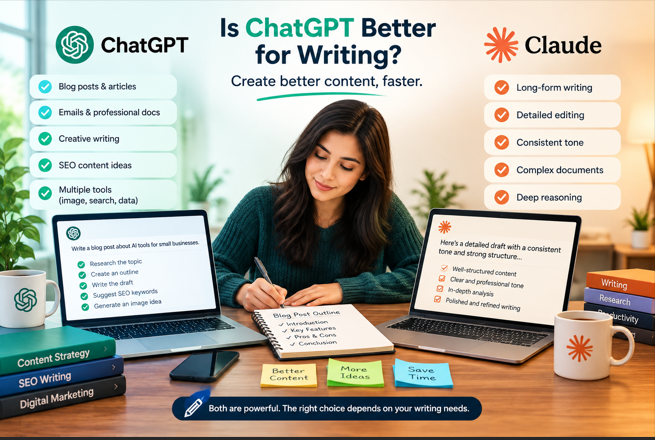
Both AI assistants can write blog posts, emails, product descriptions, reports, social media content, and other documents.
ChatGPT can be useful when writing is connected to other tools. A content marketer can research a topic, analyze a spreadsheet, create an image, and produce supporting copy inside one workflow.
Claude is also designed for detailed professional writing and long-form work. Anthropic’s Sonnet models emphasize instruction following, long-context reasoning, and professional knowledge work.
Real-World Writing Example
Imagine a US marketing agency needs a 2,000-word article about AI software.
ChatGPT can help with:
- Topic research
- Article structure
- SEO ideas
- Drafting
- Image generation
- Spreadsheet analysis
- Content revisions
Claude can help with:
- Long-form drafting
- Editing
- Maintaining a consistent tone
- Reviewing long documents
- Analyzing detailed instructions
- Code and technical documentation
The better fit depends on the agency’s workflow.
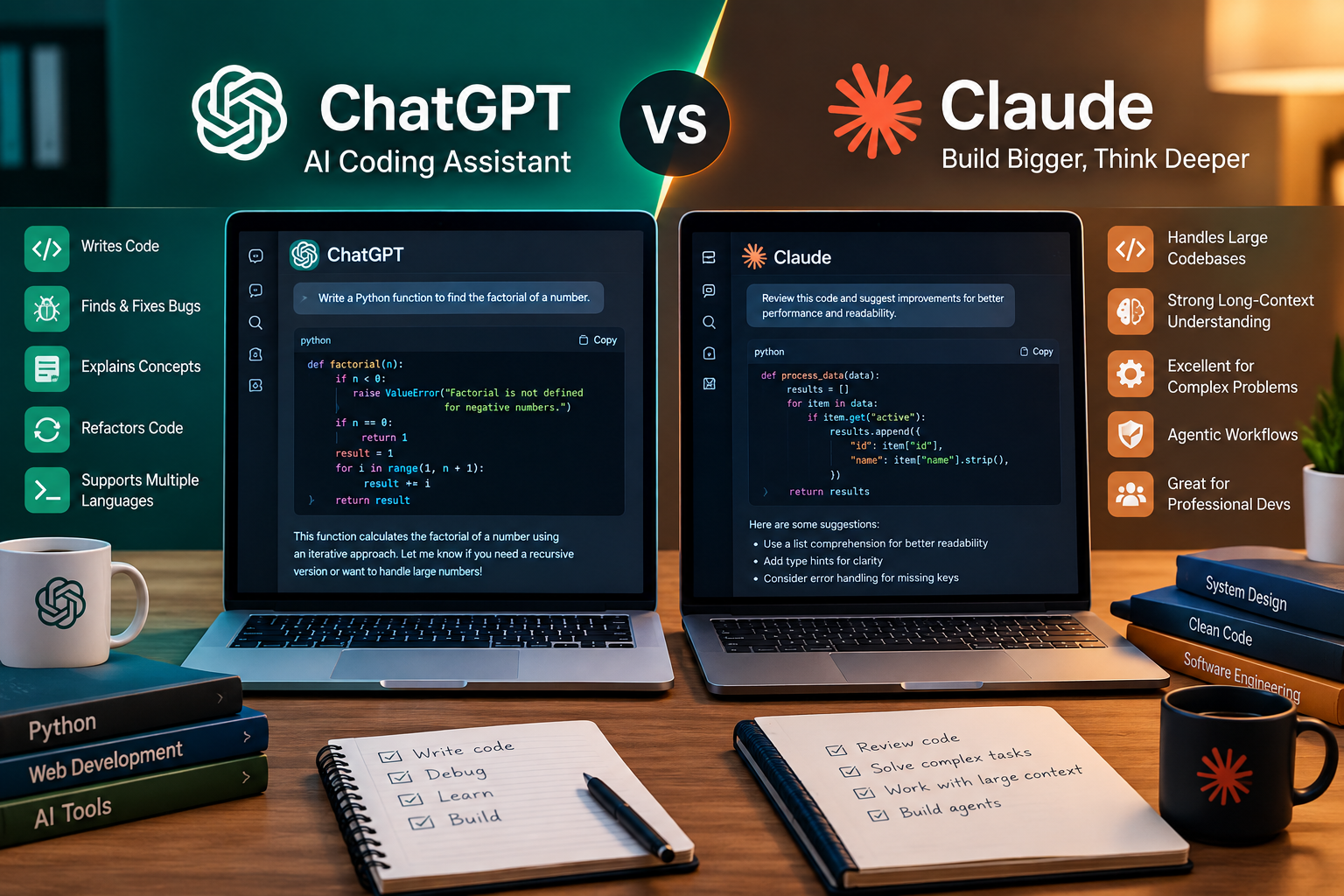
ChatGPT vs Claude for Coding
Coding is another major area of competition.
Both platforms can generate code, explain programming concepts, debug errors, refactor existing code, and help developers understand technical documentation.
Claude has placed significant emphasis on coding and agentic software development. Anthropic says Claude Sonnet 4.6 supports coding, computer use, agent planning, and long-context reasoning, with a 1-million-token context window in beta. Anthropic also positions newer Opus models for serious coding and AI-agent workflows.
ChatGPT also supports coding workflows through its models and Codex-related capabilities. OpenAI’s current paid plans provide access to advanced reasoning and coding tools, with availability depending on the plan.
Coding Example
A software developer working on a large application could use either tool to:
- Explain unfamiliar code
- Find bugs
- Write functions
- Generate tests
- Refactor code
- Create documentation
- Review implementation ideas
For very large codebases, context-window requirements can become especially important.
ChatGPT vs Claude for Research
Research workflows require more than producing fluent answers. Users often need source discovery, document analysis, summarization, comparison, and fact checking.
ChatGPT supports web search and can cite sources when searching for current information. ChatGPT Plus also includes Deep Research tools where available Best AI Tools for Passive Income.
Claude can work with large amounts of information and is positioned by Anthropic for research and professional knowledge work. Anthropic has also introduced Claude Science for research workflows and auditable artifacts.
For researchers, the important questions are:
- Does the tool provide the sources you need?
- Can it handle your document size?
- Can it follow your research instructions?
- Can you verify its claims?
- Does its workflow fit your research process?
ChatGPT vs Claude Pros and Cons
ChatGPT Pros
- Broad collection of AI tools
- Web search and current information workflows
- Image generation
- File uploads and analysis
- Data-analysis capabilities
- Voice conversations
- Custom GPT functionality
- Multiple subscription options
- Strong general-purpose workflow
ChatGPT Cons
- Usage limits can vary by plan
- Advanced capabilities may require a paid subscription
- Model availability can change
- AI-generated information still needs verification
Claude Pros
- Strong long-context capabilities
- Strong focus on coding
- Useful for long documents
- Professional knowledge-work features
- Agent-oriented development
- Multiple model options
- Claude Code for developer workflows
Claude Cons
- Some capabilities differ from ChatGPT’s broader tool ecosystem
- Feature availability varies by plan
- API and consumer pricing are separate considerations
- AI responses still require human verification
ChatGPT vs Claude Performance Comparison
Performance should be evaluated according to the actual task instead of using one overall score.
| Task | ChatGPT | Claude |
|---|---|---|
| General questions | Strong | Strong |
| Blog writing | Strong | Strong |
| Long-form editing | Strong | Strong |
| Coding | Strong | Strong |
| Large-context work | Strong | Strong |
| Web research | Strong | Strong |
| Image generation | Available | Not a primary feature |
| Data analysis | Available | Available |
| Voice interaction | Available | Available |
| AI agents | Available | Available |
| Business workflows | Strong | Strong |
Claude’s current Sonnet and Opus offerings emphasize long-context reasoning, coding, agents, and professional work. ChatGPT’s current product combines reasoning models with tools such as file analysis, image generation, web search, voice, and data analysis.
ChatGPT vs Claude Pricing in 2026
Pricing changes frequently, so users should verify the official pricing page before subscribing.
ChatGPT Pricing
OpenAI currently lists several consumer plans. ChatGPT Go is available in the US for $8 per month, while ChatGPT Plus is $20 per month. OpenAI also offers Pro tiers, including a $100 option; the $200 Pro plan is currently paused for new sign-ups and upgrades as of September 10, 2026.
| ChatGPT Plan | US Price | General Use |
|---|---|---|
| Free | $0 | Basic AI access |
| Go | $8/month | Higher everyday usage |
| Plus | $20/month | Advanced tools and reasoning |
| Pro | $100/month | Higher usage and advanced capabilities |
| Pro | $200/month | Highest usage tier; new sign-ups paused |
Claude Pricing
Claude offers free and paid consumer access, with Pro historically priced at $20 per month in the US. Anthropic also offers higher-usage plans and enterprise options.
For developers, API pricing is separate from consumer subscriptions. Anthropic’s current model pricing varies by model. For example, Anthropic lists Sonnet 5 at $2 per million input tokens and $10 per million output tokens, while Opus 5.5 is listed at $4 per million input tokens and $20 per million output tokens.
| Claude Option | Price Structure | General Use |
|---|---|---|
| Free | $0 | Basic Claude access |
| Pro | Around $20/month | Higher individual usage |
| Max | Higher monthly plans | Heavy individual usage |
| Team | Business pricing | Team collaboration |
| Enterprise | Custom | Enterprise workflows |
| API | Usage based | Developers and applications |
ChatGPT vs Claude for Businesses
Businesses can use either platform for marketing, customer support, research, documentation, coding, analysis, and productivity.
A small business might use ChatGPT to create social media posts, analyze sales data, create images, and research competitors.
A software company might use Claude for code review, documentation, large project analysis, and agentic development.
A larger organization should evaluate:
- Data controls
- Administration
- User management
- Security requirements
- Integration requirements
- API pricing
- Usage limits
- Compliance needs
- Existing software ecosystem
The best business decision depends on the company’s technical requirements and workflow.
How to Choose Between ChatGPT and Claude
Use your primary workflow as the deciding factor.
Choose ChatGPT When You Need
- A broad AI tool ecosystem
- Image generation
- Web search
- Data analysis
- File analysis
- Voice interaction
- Custom GPTs
- Multiple integrated productivity features
Consider Claude When You Need
- Long-context document work
- Coding-focused workflows
- Detailed technical analysis
- Agent-style development
- Large amounts of project context
- Professional knowledge work
You can also use both. Many professionals compare outputs from multiple AI systems before using the final result.
FAQs About ChatGPT vs Claude
1. Is ChatGPT better than Claude?
There is no single answer for every user. ChatGPT and Claude have overlapping capabilities but different product ecosystems and workflows. Your choice should depend on whether you prioritize tools such as image generation and web research or workflows centered on long-context reasoning, coding, and professional tasks.
2. Is Claude better for coding?
Claude is strongly focused on coding and agentic software development. Anthropic’s current models are designed for coding, computer use, agents, and long-context reasoning. ChatGPT also provides coding and reasoning capabilities, including Codex-related workflows on eligible plans Most Powerful AI Tools Today.
3. Is ChatGPT better for writing?
Both can produce high-quality writing. ChatGPT offers a wider collection of supporting tools, while Claude is also designed for long-form writing and professional knowledge work. The output can vary based on the prompt, model, instructions, and editing process.
4. Is Claude cheaper than ChatGPT?
Consumer pricing depends on the plan. ChatGPT Plus is currently $20 per month in the US. Claude Pro has historically been priced at $20 per month in the US. Higher tiers and API pricing differ considerably.
5. Can I use ChatGPT and Claude together?
Yes. A user can use both AI assistants for different workflows. For example, one tool can be used to create a first draft while the other reviews structure, code, reasoning, or clarity. Human review remains important for factual and professional content.
Conclusion: ChatGPT vs Claude in 2026
ChatGPT vs Claude is not simply a competition between two chatbots. Both platforms now cover writing, coding, research, document analysis, reasoning, and professional workflows.
ChatGPT provides a broad ecosystem that combines AI models with tools such as web search, image generation, file analysis, data analysis, voice, and custom GPT functionality.
Claude places substantial emphasis on long-context work, coding, agents, and professional knowledge tasks. Its current model family includes options built for demanding coding and agentic workflows.
For a US user choosing between the two, the practical question is simple: Which workflow do you need every day? A content creator may value different features from a software developer. A researcher may have different requirements from a small-business owner.
Both platforms are powerful AI assistants. Testing the same real-world tasks in both tools is one of the most useful ways to determine which fits your workflow