AI writing tools help bloggers, students, marketers, freelancers, and businesses create content faster. However, choosing the right platform can be difficult. Some tools are better for blog posts, while others focus on grammar, marketing campaigns, or SEO content.
This best AI writing tools comparison guide for USA users compares popular platforms for 2026. You will learn about their key features, advantages, disadvantages, performance, pricing, and ideal use cases. Whether you run a small business, manage a website, or create content for clients, this guide will help you choose a suitable tool. Best AI writing tools in Australia.
AI can save time, but it cannot replace every part of the writing process. Human review, reliable research, original examples, and fact-checking remain important for high-quality content. Best AI tools for article writing for free. Jasper vs Adobe Express: Which Tool Wins in 2026
What Are AI Writing Tools?
AI writing tools are software applications that use artificial intelligence to generate, edit, summarize, or improve written content. They can help users create blog articles, product descriptions, emails, social media captions, advertisements, and business documents.Best AI Tools for Small Business USA in 2026
For example, a US-based e-commerce store can use AI to prepare product des cription drafts. A freelance writer can use it to brainstorm article ideas, while a marketing agency can develop several versions of an advertising headline.
The best AI writing tools do more than generate text. Depending on the platform, they may also support grammar correction, brand voice, content planning, research, and marketing workflows.
Best AI Writing Tools Comparison USA: Top 5 Picks
1. ChatGPT — Best Overall AI Writing Assistant
ChatGPT is a versatile writing assistant for bloggers, freelancers, small businesses, and marketing professionals. Users can brainstorm topics, create outlines, draft articles, rewrite sentences, and develop FAQs.
Key features:
- Blog outlines and article drafts.
- Tone and style adjustments.
- Brainstorming and content planning.
- Summarization and rewriting.
- Help with headlines, emails, and social posts.
Real-world example: A US marketing freelancer can use ChatGPT to create an outline for an article about email marketing software, then research the products and add verified pricing, original examples, and useful recommendations.
Pros
- Flexible for many writing tasks.
- A free option is available.
- Useful for brainstorming and editing.
Cons
- Facts and citations require verification.
- Output may sound generic without detailed instructions.
- SEO research and keyword analysis may require additional tools.
2. Jasper AI — Best for Marketing Teams
Jasper is designed for marketing content and businesses that need consistent messaging across campaigns. Its features are especially relevant to teams producing advertising copy, landing pages, brand messaging, and other marketing assets.
Key features:
- Marketing-focused content generation.
- Brand voice and style support.
- Campaign content creation.
- Reusable workflows for marketing tasks.
- Support for team-based content production.
Real-world example: A US skincare company launching a new product can use Jasper to prepare draft email campaigns, landing-page copy, and social media captions that follow its brand guidelines. Best writing tool for bloggers.
Pros
- Focused on marketing workflows.
- Useful for maintaining a consistent brand voice.
- Suitable for teams producing content at scale.
Cons
- Paid plans may be expensive for solo bloggers.
- Generated marketing claims need review.
- May be unnecessary for occasional writing tasks.
Visit the official Jasper website.
3. Grammarly — Best for Grammar and Editing
Grammarly helps writers improve spelling, grammar, clarity, tone, and sentence structure. It is particularly useful when a draft already exists and needs polishing before publication.
Key features:
- Grammar and spelling suggestions.
- Clarity and tone improvements.
- Sentence rewriting.
- Writing assistance across supported applications.
- Additional AI writing features depending on the plan.
Real-world example: A US college student can use Grammarly to identify unclear sentences in an essay, correct grammar mistakes, and improve readability while keeping the student’s own ideas and arguments.
Pros
- Easy to use for everyday writing.
- Helps improve clarity and correctness.
- Offers a free plan.
Cons
- It is not a complete replacement for SEO research software.
- Suggestions can change the intended meaning.
- Advanced features require a paid plan.
4. Copy.ai — Best for Sales and Marketing Workflows
Copy.ai focuses on sales and go-to-market workflows as well as content-related tasks. It may suit businesses that want to organize repetitive marketing activities rather than simply generate a paragraph. Writing AI tools list.
Key features:
- Sales and marketing workflow support.
- Short-form copy generation.
- Content templates and structured processes.
- Assistance with campaign messaging.
- Business-focused automation features.
Real-world example: A US software company can use an AI-assisted workflow to prepare draft outreach emails for different customer segments. A sales representative should personalize every message and confirm that its claims are accurate.
Pros
- Useful for structured business workflows.
- Supports marketing and sales content tasks.
- Can help teams standardize repetitive work.
Cons
- Some capabilities are aimed at business teams rather than individuals.
- Plan limits and available features vary.
- Human review remains necessary before sending campaigns.
5. Writesonic — Best for SEO and Search Visibility Workflows
Writesonic is relevant to marketers and website owners interested in SEO content and visibility across search and AI-powered discovery platforms. Its current offering should be evaluated according to the specific features included in each plan.
Key features:
- AI-assisted content workflows.
- Search-focused marketing capabilities.
- Content planning and optimization support, depending on the plan.
- Tools related to brand visibility and AI search.
- Support for marketing research workflows.
Real-world example: A US travel website can use an appropriate SEO platform to plan an article about family-friendly destinations, identify information gaps, and improve its content brief. The writer should verify travel details and add original insights before publishing.
Pros
- Relevant to search-focused marketers.
- Can support content planning and marketing research.
- Useful for teams with broader search visibility goals.
Cons
- Advanced capabilities may require a higher-priced plan.
- Not every feature is necessary for a beginner.
- Search visibility tools cannot guarantee rankings.
Visit the Writesonic website to review its current offering.
AI Writing Tools: Key Features Comparison
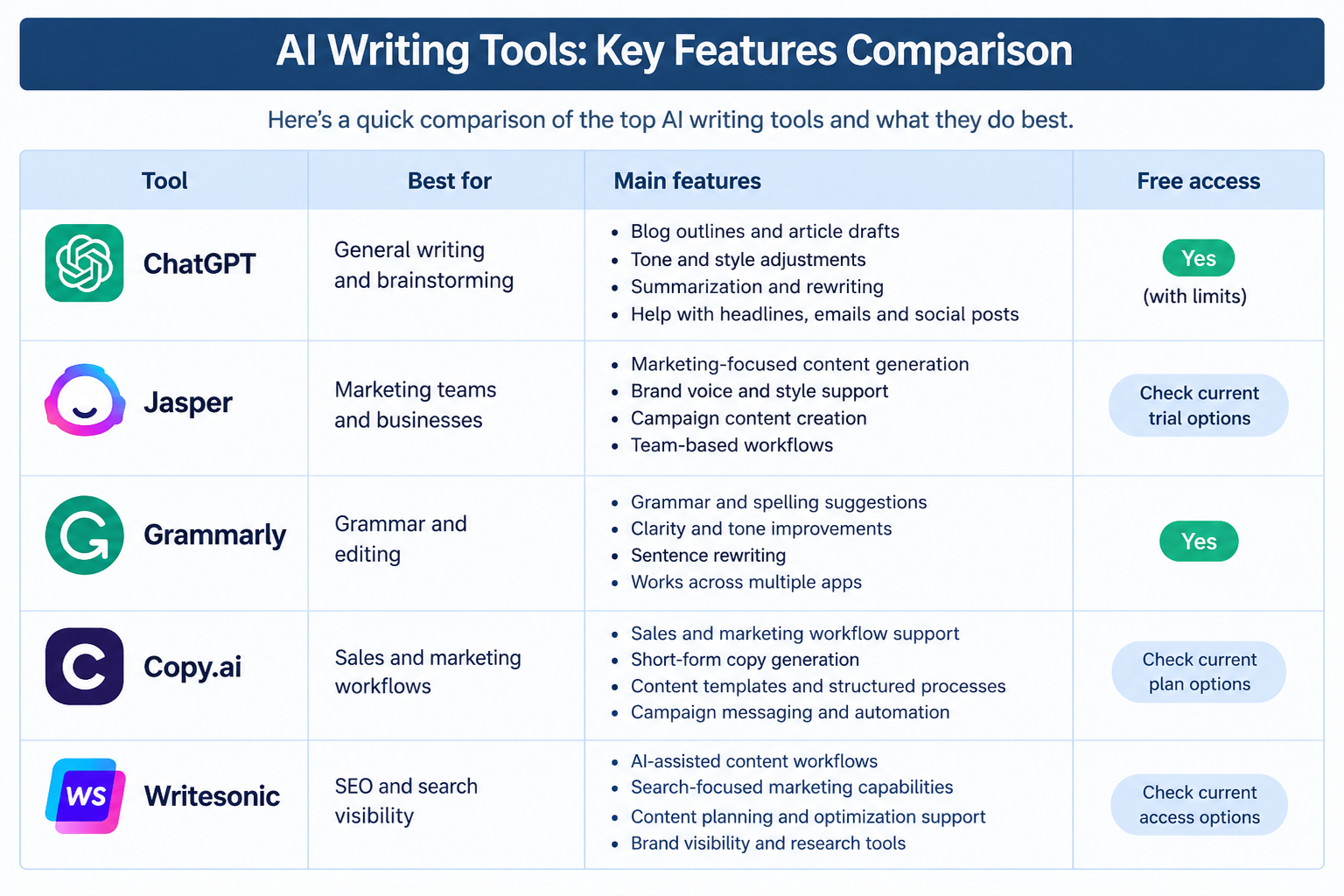
The following comparison summarizes the main differences between these platforms.
| Tool | Best for | Main strength | Free access |
|---|---|---|---|
| ChatGPT | General writing | Flexible drafting and brainstorming | Yes, with limits |
| Jasper | Marketing teams | Brand-focused marketing workflows | Check current trial options |
| Grammarly | Editing | Grammar, clarity, and tone | Yes |
| Copy.ai | Sales and marketing | Structured business workflows | Check current plan options |
| Writesonic | SEO and search visibility | Search-focused marketing tools | Check current access options |
Free access does not mean unlimited usage. Features, quotas, and eligibility can change, so check each provider’s official website before signing up.
Pros and Cons of AI Writing Tools
Advantages of AI Writing Software
- Faster first drafts: Create an outline or starting draft in less time.
- More ideas: Generate potential headlines, topics, and content angles.
- Improved readability: Editing tools can identify grammar and clarity issues.
- Flexible content formats: Develop drafts for blogs, emails, ads, and product pages.
- Support for small businesses: Help teams with limited writing resources produce initial content.
Disadvantages of AI Writing Software
- Possible inaccuracies: AI-generated statements may be outdated or incorrect.
- Generic writing: Repeated prompts can produce similar-sounding articles.
- Editing requirements: Drafts need human review and fact-checking.
- Additional costs: Premium plans and separate SEO tools can increase expenses.
- Originality concerns: Users must check sources, avoid copying, and contribute original value.
AI should support a writer’s expertise rather than replace independent judgment. Google’s guidance on creating helpful, reliable, people-first content is a useful reference for website owners.
AI Writing Tools Performance Comparison
There is no single winner for every writing task. The table below provides a practical, use-case-based assessment rather than claiming that every product has undergone identical laboratory testing.
| Tool | Blog drafting | Editing | Marketing | SEO workflow support |
|---|---|---|---|---|
| ChatGPT | Strong | Good | Good | Moderate with appropriate instructions |
| Jasper | Good | Good | Strong | Depends on workflow and integrations |
| Grammarly | Limited as a primary drafting tool | Strong | Useful for polishing copy | Limited |
| Copy.ai | Useful for drafts | Useful | Strong for structured workflows | Depends on the workflow |
| Writesonic | Depends on selected features | Useful | Good for search-focused tasks | Stronger focus on search visibility |
These assessments are editorial judgments based on each tool’s intended use, not measured speed or independently verified quality scores. Actual results depend on the prompt, plan, workflow, and writer’s skill.
Which AI Writer Performs Best for Real-World Tasks?
- Writing a blog outline: ChatGPT is a practical starting point.
- Maintaining marketing consistency: Jasper is worth considering.
- Correcting grammar: Grammarly is the most specialized option in this group.
- Organizing sales content: Copy.ai is a relevant choice.
- Supporting search-focused marketing: Writesonic is worth evaluating.
For a small website, combining a general-purpose AI assistant with a dedicated editing tool may be more economical than buying several premium subscriptions.
AI Writing Tools Pricing Comparison USA
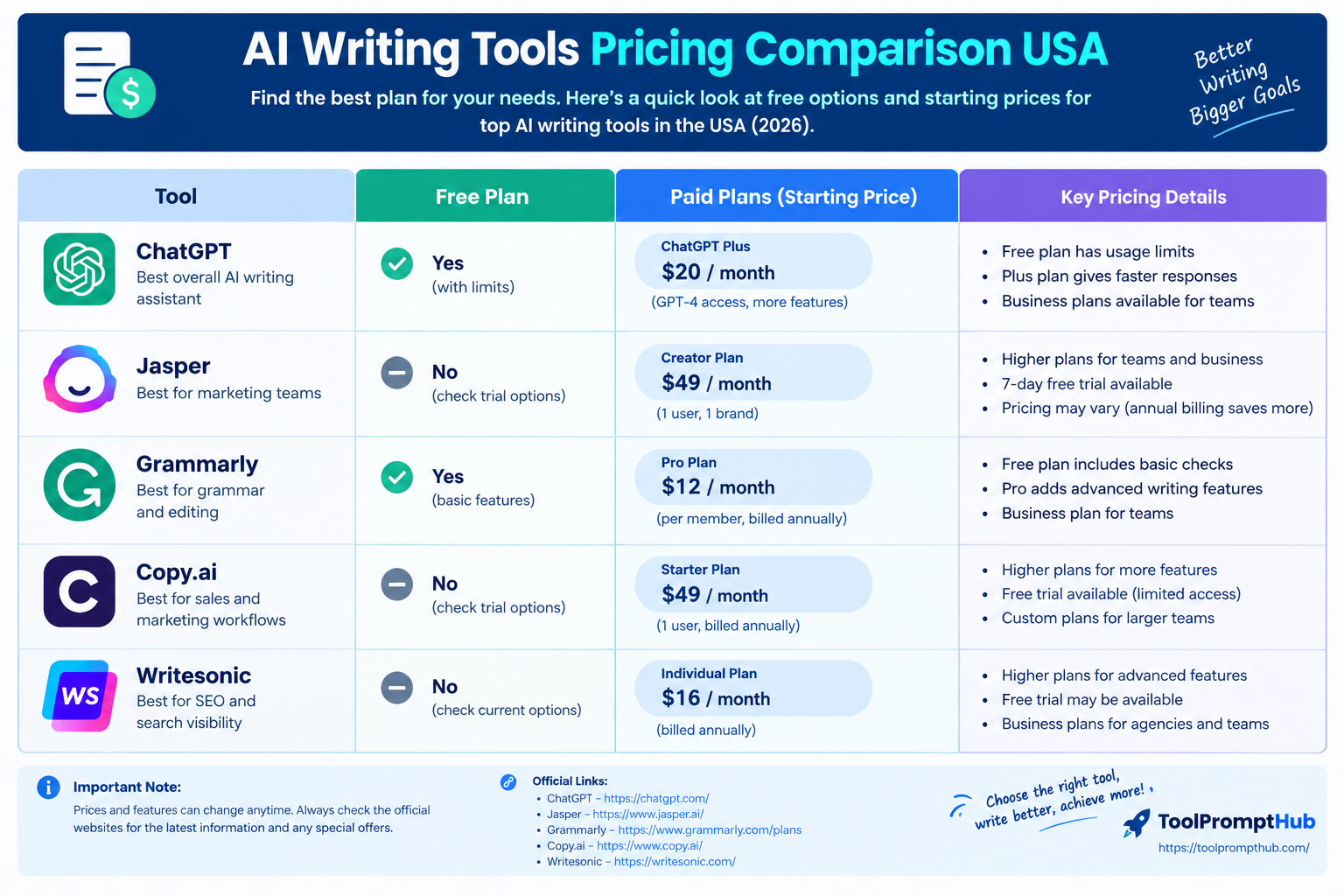
Pricing changes frequently. The table below separates free access from paid-plan estimates and directs readers to official sources where possible.
| Tool | Free option | Paid pricing guidance |
|---|---|---|
| ChatGPT | Yes, with limits | ChatGPT Plus has commonly been listed at $20/month |
| Jasper | Check current trial availability | Marketing plans have been listed around $59 per seat/month with annual billing |
| Grammarly | Yes | Pro has been listed at $12/month per member with annual billing |
| Copy.ai | Verify current options | Pricing depends on the available plan and billing terms |
| Writesonic | Verify current options | Pricing depends on the current product and plan |
Prices are indicative, not a guarantee of the amount charged today. Taxes, billing frequency, regional availability, promotions, and plan changes may affect the final cost. Check the official pricing pages before purchasing.
How to Choose an AI Writing Tool on a Budget
A beginner does not need five subscriptions to start writing.
- Start with a free tool and test it on a real task.
- Identify the biggest problem: drafting, grammar, SEO research, or marketing workflow.
- Pay only for features you will use regularly.
- Calculate the monthly cost against the time saved.
- Review cancellation terms and usage limits before upgrading.
For example, an independent blogger may prefer ChatGPT for drafting and Grammarly for editing. A marketing agency producing many campaigns may benefit more from a specialized marketing platform.
FAQs About the Best AI Writing Tools
1. What is the best AI writing tool in the USA in 2026?
ChatGPT is a practical all-around choice for brainstorming and drafting. Jasper suits marketing teams, Grammarly specializes in editing, Copy.ai supports structured business workflows, and Writesonic is relevant to search-focused marketing.
2. Which AI writing tool is best for bloggers?
ChatGPT is a useful starting point for outlines, drafts, and FAQs. Bloggers who need advanced SEO research may also consider specialized SEO software. Always fact-check claims and add original experience before publishing.
3. Are there free AI writing tools?
Yes. ChatGPT and Grammarly offer free access with limitations. Other providers may offer trials or limited access depending on their current plans. Review usage limits before relying on a free plan for business work.
4. Can AI writing tools help with Google rankings?
They can help with planning, drafting, and editing, but they do not guarantee rankings. Successful content should satisfy search intent, provide accurate information, demonstrate appropriate expertise, and offer value beyond a generic AI-generated draft.
5. Are paid AI writing tools worth the money?
They can be worthwhile if they save enough time or provide features you genuinely need. Compare the subscription cost with your workload, editing time, and business goals before upgrading.
Conclusion:
The best choice depends on your writing goals and budget.
ChatGPT is the best starting point for most individual writers because it can support brainstorming, outlines, first drafts, and revisions. Jasper is a strong candidate for marketing teams that need brand consistency. Grammarly is the specialist choice for editing. Copy.ai is worth considering for structured sales and marketing workflows, while Writesonic is relevant to businesses focused on search visibility.
For USA bloggers, freelancers, and small business owners, the smartest approach is to start with one tool, test it on real work, and add paid software only when a clear need appears.
AI can help you work faster, but original research, useful examples, accurate facts, and careful editing are what make a published article valuable to readers.