Midjourney vs DALL·E is still a useful search comparison for creators who want to make AI images for websites, social media, ads, presentations, product concepts, and marketing. The two names became popular for different reasons. Midjourney built a strong reputation for artistic image quality and visual style. DALL·E became known for understanding detailed natural-language prompts and making image creation feel simple.
Midjourney now has newer model updates, while OpenAI has moved its image-generation experience beyond the standalone DALL·E brand. DALL·E 3 is deprecated in the OpenAI API, and OpenAI says the official DALL·E GPT has been retired from ChatGPT. Midjourney vs DALL·E is still a useful search comparison for creators who want to make AI images for websites, social media, ads, presentations, product concepts, and marketing. The two names became popular for different reasons. Midjourney built a strong reputation for artistic image quality and visual style. DALL·E became known for understanding detailed natural-language prompts and making image creation feel simple.
The 2026 market is different. Midjourney now has newer model updates, while OpenAI has moved its image-generation experience beyond the standalone DALL·E brand. DALL·E 3 is deprecated in the OpenAI API, and OpenAI says the official DALL·E GPT has been retired from ChatGPT. Current OpenAI image generation uses newer GPT Image models and ChatGPT Images. This makes the comparison useful as a historical model comparison, but buyers should also understand what each platform offers today. Canva vs Adobe Express – Best Design Tool
What Is Midjourney?
Midjourney is an AI image-generation platform designed around text prompts, image references, visual experimentation, and creative control. In 2026, Midjourney lists V8.2 as its default model, released on July 24, 2026. Its current toolset includes personalization, style references, editing features, multiple speed modes, and image creation workflows designed for creative iteration.
Midjourney is popular with people who care about visual polish. It can produce cinematic scenes, stylized portraits, fantasy artwork, concept art, editorial visuals, and strong brand mood boards.
Real-world example: A US clothing brand can describe a summer campaign in a desert setting, generate several visual directions, then refine the composition and style until the concept matches the campaign mood.
Midjourney also offers different subscription levels and includes private Stealth Mode on Pro and Mega plans. Standard, Pro, and Mega plans support unlimited image generations in Relax Mode.
What Is DALL·E?
DALL·E 3 was OpenAI’s text-to-image model built to understand more nuance and detail from natural-language prompts. OpenAI described DALL·E 3 as a major improvement in following written image descriptions and integrated it with ChatGPT so users could refine ideas conversationally.
A key part of its appeal was simplicity. Instead of learning many complex controls, users could describe an image in normal language and let ChatGPT help shape the prompt.
In 2026, the status of DALL·E matters. OpenAI’s current documentation marks DALL·E 3 as deprecated and removed from the API. OpenAI also says the official DALL·E GPT has been retired from ChatGPT. The current image experience uses ChatGPT Images, while developers are directed toward GPT Image 2.5 models for current image generation and editing.
Midjourney vs DALL·E: Key Features Comparison
| Feature | Midjourney | DALL·E 3 |
|---|---|---|
| Main strength | Artistic and cinematic visuals | Natural-language prompt understanding |
| Current status | Active platform, V8.2 default | Deprecated/retired as a current OpenAI product |
| Prompt style | Text plus creative parameters and references | Simple natural-language descriptions |
| Style control | Strong, with style references and personalization | Simpler, less parameter-heavy |
| Editing | Strong creative editing workflow | Historically strong conversational generation |
| Photorealism | Very strong for many creative scenes | Strong, but model is no longer OpenAI’s current image option |
| Text in images | Improved, with model-dependent results | Improved over older DALL·E versions |
| Commercial workflow | Subscription plans and private options | Current OpenAI workflows use newer image models |
| Best fit | Designers, creators, visual marketers | Users researching the DALL·E 3 generation era |
Midjourney’s current documentation lists Style Reference, Stylize, Raw Mode, image prompts, Relax Mode, Fast Mode, Draft, and other controls.
Midjourney Pros and Cons
Pros of Midjourney
- Excellent artistic quality for many creative image categories.
- Strong control over visual mood, composition, and style.
- Style Reference and personalization help build consistent creative directions.
- Useful for concept art, advertising ideas, thumbnails, posters, and brand visuals.
- Active development, with V8.2 now the default model.
Cons of Midjourney
- Beginners may need time to learn its controls and workflow.
- Subscription plans can become expensive for heavy users.
- Results can be intentionally artistic when a user wants a very literal image.
- Private generation requires a Pro or Mega plan through Stealth Mode.
DALL·E Pros and Cons
Pros of DALL·E 3
- Strong natural-language prompt interpretation.
- Conversational prompting made it easy for beginners.
- Worked well for users who preferred describing an idea instead of learning many parameters.
- Built directly into ChatGPT during its active product period.
Cons of DALL·E 3
- DALL·E 3 is now deprecated and removed from the OpenAI API.
- The official DALL·E GPT is retired from ChatGPT.
- New projects should use OpenAI’s current GPT Image models instead.
- Its current status makes it a poor choice for a new production workflow compared with supported image-generation options.
Midjourney vs DALL·E Performance Comparison
There is no single image AI that wins every task. The output can change with the prompt, image references, settings, model version, and desired style.
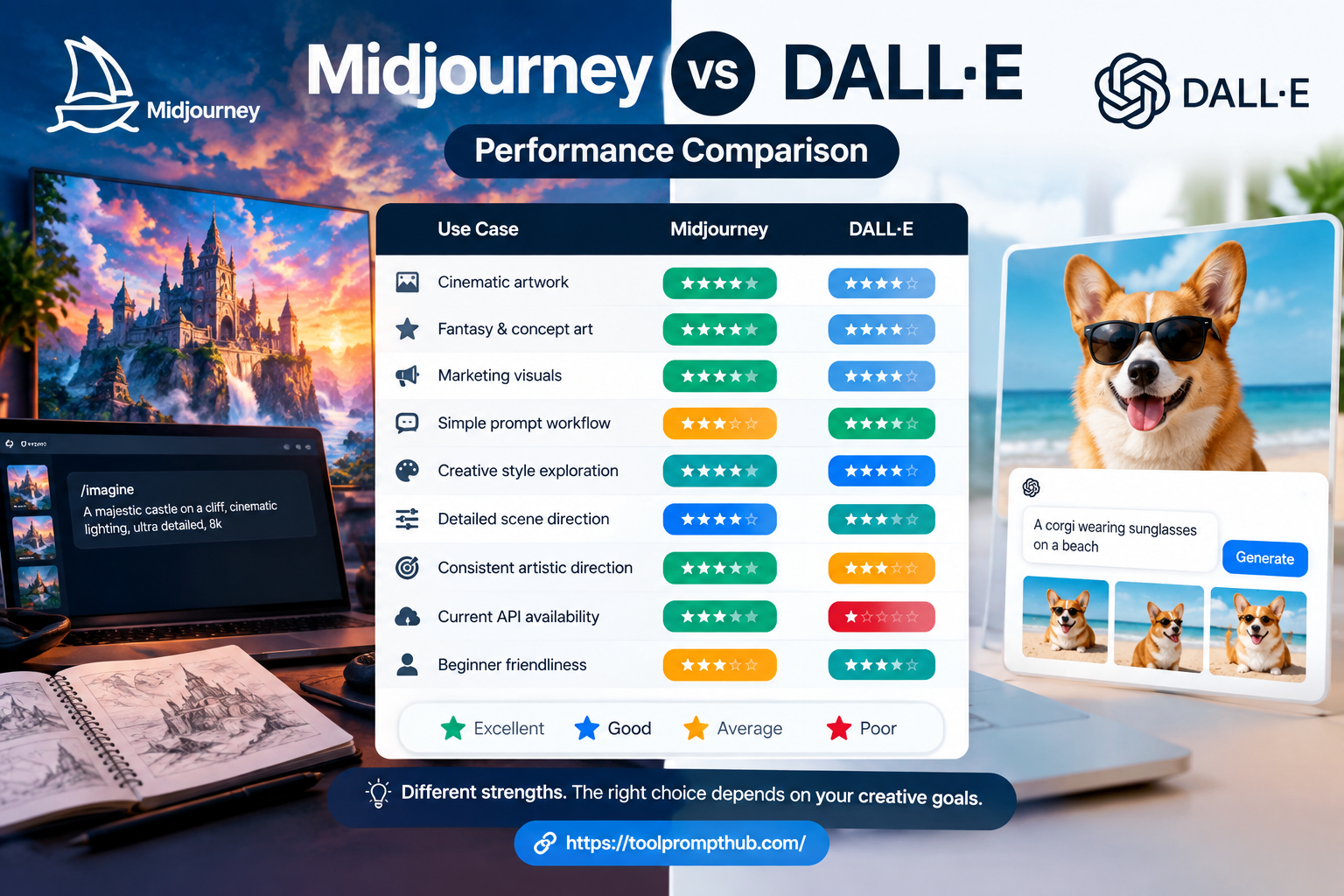
| Use Case | Midjourney | DALL·E 3 |
|---|---|---|
| Cinematic artwork | Excellent | Very good |
| Fantasy and concept art | Excellent | Very good |
| Marketing visuals | Excellent | Very good |
| Simple prompt workflow | Good | Excellent |
| Creative style exploration | Excellent | Very good |
| Detailed scene direction | Very good | Excellent |
| Consistent artistic direction | Excellent | Good |
| Current API availability | Active | Deprecated |
| Beginner friendliness | Good | Excellent during active period |
Midjourney V8.2 focuses on aesthetics, image quality, personalization, and a new Edit Model. Midjourney’s V8.1 documentation also describes HD image support and faster rendering improvements compared with earlier versions.
For SEO teams, this difference also matters because image tools change quickly, and older comparison pages can become outdated when models, access, and pricing change.
Midjourney Pricing in 2026
Midjourney currently lists four subscription tiers. Basic is $10 per month, Standard is $30, Pro is $60, and Mega is $120. Annual billing provides a 20% discount, with yearly prices of $96, $288, $576, and $1,152 respectively.
| Plan | Monthly Price | Annual Price | Fast GPU Time |
|---|---|---|---|
| Basic | $10 | $96/year | 3.3 hours/month |
| Standard | $30 | $288/year | 15 hours/month |
| Pro | $60 | $576/year | 30 hours/month |
| Mega | $120 | $1,152/year | 60 hours/month |
Standard, Pro, and Mega plans include unlimited image generations in Relax Mode. Pro and Mega include Stealth Mode for private creations.
DALL·E Pricing and Current OpenAI Image Costs
DALL·E 3 no longer has a current API price because OpenAI has deprecated and removed it from the API.
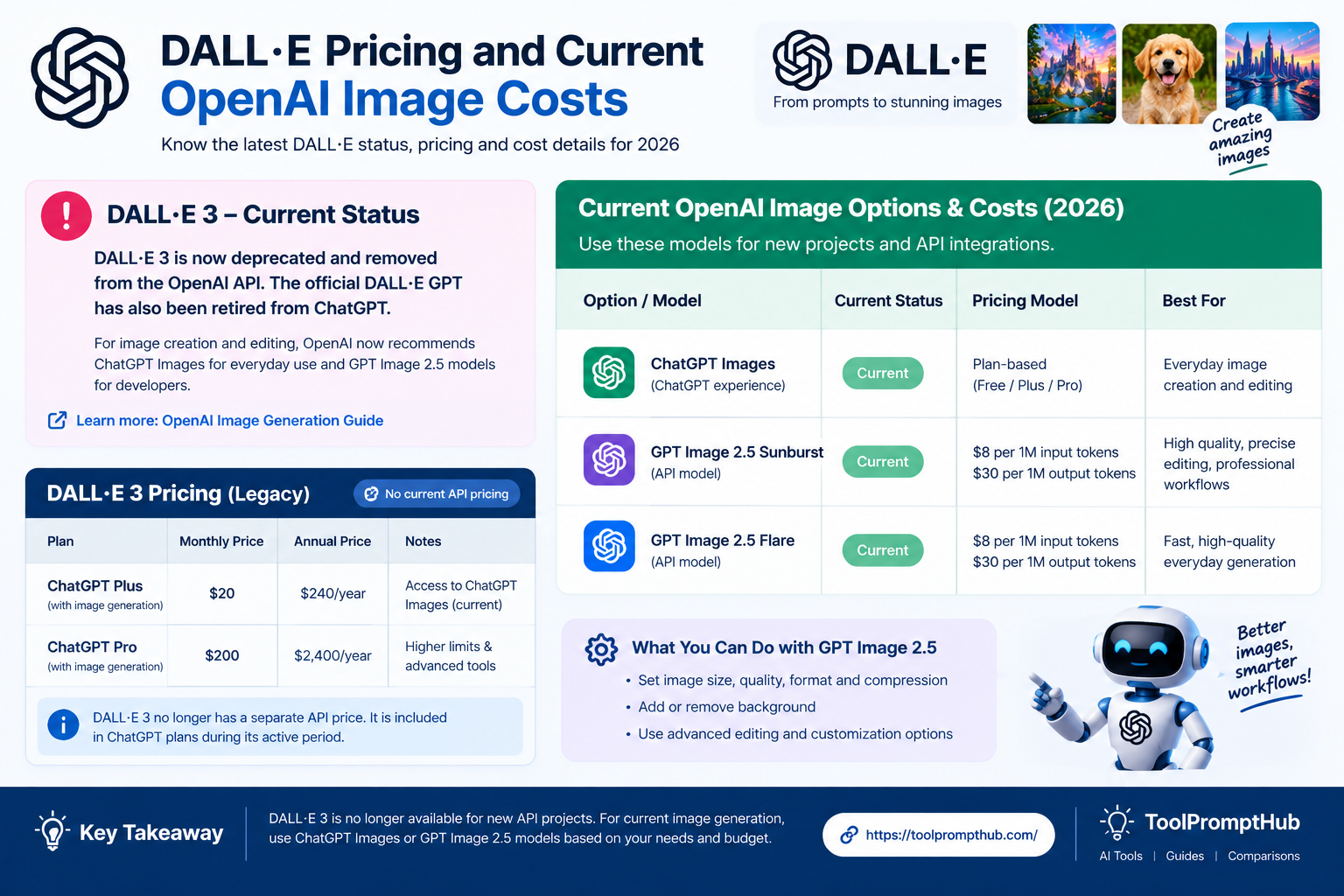 For new developer projects, OpenAI currently recommends GPT Image 2.5. The GPT Image 2.5 Sunburst and Flare models use image-token pricing of $8 per million image input tokens and $30 per million image output tokens. The model choice differs by workflow: Sunburst is positioned for higher image quality and precise editing, while Flare is optimized for faster everyday generation.
| OpenAI Option | Current Status | Pricing Model |
|---|---|---|
| DALL·E 3 API | Deprecated/removed | No current API pricing |
| ChatGPT Images | Current ChatGPT experience | Plan-based ChatGPT access |
| GPT Image 2.5 Sunburst | Current API model | Token-based |
| GPT Image 2.5 Flare | Current API model | Token-based |
Developers can customize current GPT Image outputs by size, quality, format, compression, and background settings.
Real-World Examples for US Creators and Businesses
A real estate agent in Texas could use Midjourney to create a polished lifestyle concept for a luxury listing brochure. The agent could explore multiple architectural moods before final photography.
A YouTube creator in California could use AI image generation for video thumbnails, fantasy backgrounds, and story concepts. Midjourney can be useful when the thumbnail needs a strong visual identity.
A small ecommerce brand could use image generation to brainstorm product campaigns before paying for a full photo shoot. AI outputs can help test creative directions, headlines, packaging concepts, and color moods.
A marketing agency might prefer a conversational OpenAI workflow when the team already uses ChatGPT and needs to move from written campaign ideas into images and edits. For current workflows, the relevant OpenAI option is the newer ChatGPT Images/GPT Image family rather than DALL·E 3.
For more AI-tool comparisons and practical guides, connect this article internally to your existing ToolPromptHub content, such as your [Jasper vs Copy.ai comparison] Jasper vs Copy.ai comparison and [Best AI Tools for Passive Income] Best AI Tools for Passive Income articles. These internal links help readers discover related content and give search engines clearer topical relationships across your site.
Useful outbound references include the official [Midjourney plan comparison] Midjourney plan comparison and OpenAI’s official [image generation guide] OpenAI image generation guide, which provide current product information and pricing details.
FAQs About Midjourney vs DALL·E
Is Midjourney better than DALL·E?
They serve different creative workflows. Midjourney is an active platform with strong visual controls and a current V8.2 model. DALL·E 3 is a legacy OpenAI image model and is no longer the current API choice.
Is DALL·E still available in ChatGPT?
OpenAI says the official DALL·E GPT has been retired from ChatGPT. Users should use the current ChatGPT Images experience for image creation and editing.
Which AI image generator is best for realistic images?
Midjourney can produce highly polished realistic and cinematic images. Current OpenAI GPT Image models are designed for high-quality image generation as well. Results vary by prompt, settings, and model, so test representative images for your exact project.
Is Midjourney worth paying for?
For users who create many images, need visual experimentation, or want advanced creative controls, a subscription can fit a regular workflow. Midjourney offers Basic, Standard, Pro, and Mega plans, with higher tiers adding more GPU time and privacy features.
What should I use instead of DALL·E 3 in 2026?
For OpenAI API projects, OpenAI recommends GPT Image 2.5. Sunburst is aimed at precise editing and demanding quality, while Flare is aimed at fast, high-quality everyday image generation.
Conclusion: Midjourney vs DALL·E in 2026
Midjourney vs DALL·E is no longer a simple comparison between two equally current products. Midjourney remains an active AI image platform, with V8.2 as its current default model and a deep set of creative controls. DALL·E 3 remains important historically because it helped make natural-language image generation mainstream, but OpenAI has now deprecated it for API use and retired the standalone DALL·E GPT from ChatGPT.
For a creator who wants strong visual experimentation, artistic direction, style control, and an active dedicated image platform, Midjourney is the more direct current choice to evaluate.
For someone who wants the OpenAI ecosystem, the 2026 comparison should move beyond DALL·E 3 and examine ChatGPT Images and GPT Image 2.5 instead.
The practical choice comes down to workflow, creative control, current availability, and pricing. Use the tool that matches the images you actually need to produce, not only the name that was popular in earlier AI image-generation comparisons.
Midjourney is an AI image-generation platform designed around text prompts, image references, visual experimentation, and creative control. In 2026, Midjourney lists V8.2 as its default model, released on July 24, 2026. Its current toolset includes personalization, style references, editing features, multiple speed modes, and image creation workflows designed for creative iteration.
Midjourney is popular with people who care about visual polish. It can produce cinematic scenes, stylized portraits, fantasy artwork, concept art, editorial visuals, and strong brand mood boards.
Real-world example: A US clothing brand can describe a summer campaign in a desert setting, generate several visual directions, then refine the composition and style until the concept matches the campaign mood.
Midjourney also offers different subscription levels and includes private Stealth Mode on Pro and Mega plans. Standard, Pro, and Mega plans support unlimited image generations in Relax Mode.
What Is DALL·E?
DALL·E 3 was OpenAI’s text-to-image model built to understand more nuance and detail from natural-language prompts. OpenAI described DALL·E 3 as a major improvement in following written image descriptions and integrated it with ChatGPT so users could refine ideas conversationally.
A key part of its appeal was simplicity. Instead of learning many complex controls, users could describe an image in normal language and let ChatGPT help shape the prompt.
In 2026, the status of DALL·E matters. OpenAI’s current documentation marks DALL·E 3 as deprecated and removed from the API. OpenAI also says the official DALL·E GPT has been retired from ChatGPT. The current image experience uses ChatGPT Images, while developers are directed toward GPT Image 2.5 models for current image generation and editing.
Midjourney vs DALL·E: Key Features Comparison
| Feature | Midjourney | DALL·E 3 |
|---|---|---|
| Main strength | Artistic and cinematic visuals | Natural-language prompt understanding |
| Current status | Active platform, V8.2 default | Deprecated/retired as a current OpenAI product |
| Prompt style | Text plus creative parameters and references | Simple natural-language descriptions |
| Style control | Strong, with style references and personalization | Simpler, less parameter-heavy |
| Editing | Strong creative editing workflow | Historically strong conversational generation |
| Photorealism | Very strong for many creative scenes | Strong, but model is no longer OpenAI’s current image option |
| Text in images | Improved, with model-dependent results | Improved over older DALL·E versions |
| Commercial workflow | Subscription plans and private options | Current OpenAI workflows use newer image models |
| Best fit | Designers, creators, visual marketers | Users researching the DALL·E 3 generation era |
Midjourney’s current documentation lists Style Reference, Stylize, Raw Mode, image prompts, Relax Mode, Fast Mode, Draft, and other controls.
Midjourney Pros and Cons
Pros of Midjourney
- Excellent artistic quality for many creative image categories.
- Strong control over visual mood, composition, and style.
- Style Reference and personalization help build consistent creative directions.
- Useful for concept art, advertising ideas, thumbnails, posters, and brand visuals.
- Active development, with V8.2 now the default model.
Cons of Midjourney
- Beginners may need time to learn its controls and workflow.
- Subscription plans can become expensive for heavy users.
- Results can be intentionally artistic when a user wants a very literal image.
- Private generation requires a Pro or Mega plan through Stealth Mode.
DALL·E Pros and Cons
Pros of DALL·E 3
- Strong natural-language prompt interpretation.
- Conversational prompting made it easy for beginners.
- Worked well for users who preferred describing an idea instead of learning many parameters.
- Built directly into ChatGPT during its active product period.
Cons of DALL·E 3
- DALL·E 3 is now deprecated and removed from the OpenAI API.
- The official DALL·E GPT is retired from ChatGPT.
- Its current status makes it a poor choice for a new production workflow compared with supported image-generation options.
Midjourney vs DALL·E Performance Comparison
There is no single image AI that wins every task. The output can change with the prompt, image references, settings, model version, and desired style.
| Use Case | Midjourney | DALL·E 3 |
|---|---|---|
| Cinematic artwork | Excellent | Very good |
| Fantasy and concept art | Excellent | Very good |
| Marketing visuals | Excellent | Very good |
| Simple prompt workflow | Good | Excellent |
| Creative style exploration | Excellent | Very good |
| Detailed scene direction | Very good | Excellent |
| Consistent artistic direction | Excellent | Good |
| Current API availability | Active | Deprecated |
| Beginner friendliness | Good | Excellent during active period |
Midjourney V8.2 focuses on aesthetics, image quality, personalization, and a new Edit Model. Midjourney’s V8.1 documentation also describes HD image support and faster rendering improvements compared with earlier versions.
For SEO teams, this difference also matters because image tools change quickly, and older comparison pages can become outdated when models, access, and pricing change.
Midjourney Pricing in 2026
Midjourney currently lists four subscription tiers. Basic is $10 per month, Standard is $30, Pro is $60, and Mega is $120. Annual billing provides a 20% discount, with yearly prices of $96, $288, $576, and $1,152 respectively.
| Plan | Monthly Price | Annual Price | Fast GPU Time |
|---|---|---|---|
| Basic | $10 | $96/year | 3.3 hours/month |
| Standard | $30 | $288/year | 15 hours/month |
| Pro | $60 | $576/year | 30 hours/month |
| Mega | $120 | $1,152/year | 60 hours/month |
Standard, Pro, and Mega plans include unlimited image generations in Relax Mode. Pro and Mega include Stealth Mode for private creations.
DALL·E Pricing and Current OpenAI Image Costs
DALL·E 3 no longer has a current API price because OpenAI has deprecated and removed it from the API.
For new developer projects, OpenAI currently recommends GPT Image 2.5. The GPT Image 2.5 Sunburst and Flare models use image-token pricing of $8 per million image input tokens and $30 per million image output tokens. The model choice differs by workflow: Sunburst is positioned for higher image quality and precise editing, while Flare is optimized for faster everyday generation.
| OpenAI Option | Current Status | Pricing Model |
|---|---|---|
| DALL·E 3 API | Deprecated/removed | No current API pricing |
| ChatGPT Images | Current ChatGPT experience | Plan-based ChatGPT access |
| GPT Image 2.5 Sunburst | Current API model | Token-based |
| GPT Image 2.5 Flare | Current API model | Token-based |
Developers can customize current GPT Image outputs by size, quality, format, compression, and background settings.
Real-World Examples for US Creators and Businesses
A real estate agent in Texas could use Midjourney to create a polished lifestyle concept for a luxury listing brochure. The agent could explore multiple architectural moods before final photography.
A YouTube creator in California could use AI image generation for video thumbnails, fantasy backgrounds, and story concepts. Midjourney can be useful when the thumbnail needs a strong visual identity.
A small ecommerce brand could use image generation to brainstorm product campaigns before paying for a full photo shoot. AI outputs can help test creative directions, headlines, packaging concepts, and color moods.
A marketing agency might prefer a conversational OpenAI workflow when the team already uses ChatGPT and needs to move from written campaign ideas into images and edits. For current workflows, the relevant OpenAI option is the newer ChatGPT Images/GPT Image family rather than DALL·E 3.
For more AI-tool comparisons and practical guides, connect this article internally to your existing ToolPromptHub content, such as your [Jasper vs Copy.ai comparison] Jasper vs Copy.ai comparison and [Best AI Tools for Passive Income] Best AI Tools for Passive Income articles. These internal links help readers discover related content and give search engines clearer topical relationships across your site.
Useful outbound references include the official [Midjourney plan comparison] Midjourney plan comparison and OpenAI’s official [image generation guide] OpenAI image generation guide, which provide current product information and pricing details.
FAQs About Midjourney vs DALL·E
Is Midjourney better than DALL·E?
They serve different creative workflows. Midjourney is an active platform with strong visual controls and a current V8.2 model. DALL·E 3 is a legacy OpenAI image model and is no longer the current API choice.
Is DALL·E still available in ChatGPT?
OpenAI says the official DALL·E GPT has been retired from ChatGPT. Users should use the current ChatGPT Images experience for image creation and editing.
Is Midjourney worth paying for?
For users who create many images, need visual experimentation, or want advanced creative controls, a subscription can fit a regular workflow. Midjourney offers Basic, Standard, Pro, and Mega plans, with higher tiers adding more GPU time and privacy features.
What should I use instead of DALL·E 3 in 2026?
For OpenAI API projects, OpenAI recommends GPT Image 2.5. Sunburst is aimed at precise editing and demanding quality, while Flare is aimed at fast, high-quality everyday image generation.
Conclusion: Midjourney vs DALL·E in 2026
Midjourney vs DALL·E is no longer a simple comparison between two equally current products. Midjourney remains an active AI image platform, with V8.2 as its current default model and a deep set of creative controls. DALL·E 3 remains important historically because it helped make natural-language image generation mainstream, but OpenAI has now deprecated it for API use and retired the standalone DALL·E GPT from ChatGPT.
For a creator who wants strong visual experimentation, artistic direction, style control, and an active dedicated image platform, Midjourney is the more direct current choice to evaluate.
For someone who wants the OpenAI ecosystem, the 2026 comparison should move beyond DALL·E 3 and examine ChatGPT Images and GPT Image 2.5 instead. The practical choice comes down to workflow, creative control, current availability, and pricing.