AI tools for banking help US financial institutions improve customer service, detect suspicious transactions, automate repetitive work, and analyze financial information. Banks handle thousands of transactions, customer requests, loan applications, and security checks every day. Managing these tasks manually can increase operating costs and slow down customer service.
Artificial intelligence can help banks process information faster and identify patterns that traditional systems may miss. From digital assistants to fraud detection software, banking AI is changing how financial institutions work.
For example, a regional bank can use an AI-powered customer service assistant to answer common questions about account statements, debit cards, and payment processing. Its fraud monitoring system can also flag unusual spending for further investigation. Mortgage Broker AI Tools: Best Options for 2026 USA
However, choosing the right software requires careful research. Banks must consider data privacy, cybersecurity, regulatory requirements, integration costs, and accuracy.
This guide compares popular AI platforms and banking technology providers for the US market in 2026. It explains their features, benefits, limitations, and pricing considerations to help banks, credit unions, and financial technology teams make informed decisions. Best financial AI tools free
What Are AI Tools for Banking?
AI tools for banking are software systems that use technologies such as machine learning, natural language processing, predictive analytics, and generative AI to support financial services.
These systems analyze data, identify patterns, assist employees, and automate selected banking activities. Some tools focus on one task, while enterprise platforms support several departments. Free AI tools for finance
Common banking applications include:
- Fraud detection: Identifying unusual payment patterns and potentially suspicious transactions.
- Customer service: Answering routine questions through chatbots and virtual assistants.
- Credit analysis: Helping authorized teams assess financial information and credit risk.
- Document processing: Extracting information from forms, statements, and loan documents.
- Compliance support: Helping staff review alerts, records, and regulatory documentation.
- Cybersecurity: Detecting unusual system activity and potential threats.
- Employee productivity: Searching internal knowledge and summarizing approved business documents.
AI does not automatically make every banking decision accurate or compliant. Banks should maintain human oversight for important decisions, especially lending, fraud investigations, and customer account restrictions.
Best AI Tools for Banking in the USA: Feature Comparison
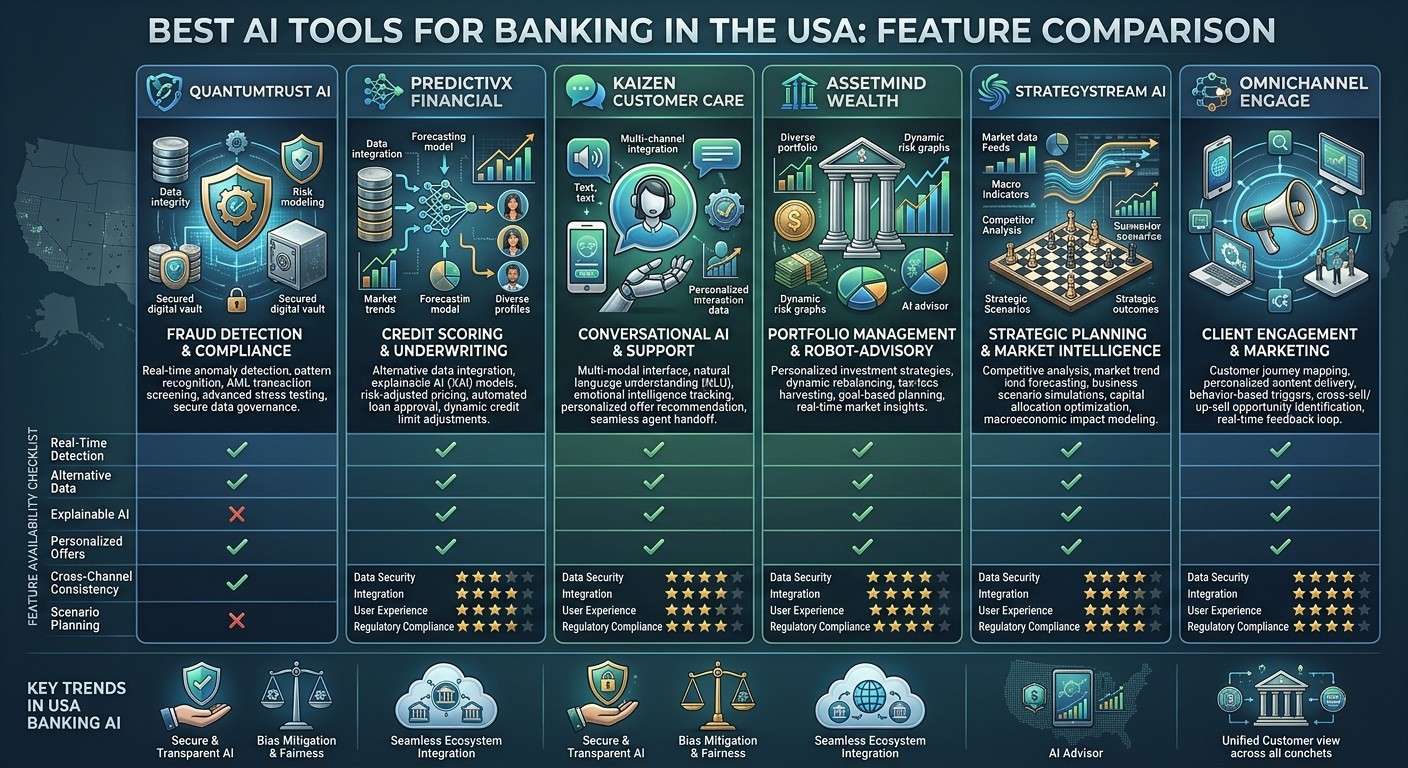
Different banking AI platforms serve different needs. Some provide general-purpose AI infrastructure, while others specialize in financial crime prevention, conversational banking, or digital banking operations.
1. Microsoft Azure AI
Microsoft Azure AI provides cloud-based AI services that financial institutions can use to build intelligent applications. Depending on the selected services and architecture, banks can develop document-processing workflows, employee assistants, predictive models, and customer support applications.AI Tools for Financial Advisors: Best Picks for 2026
Key features:
- AI application development and machine learning.
- Document analysis and information extraction.
- Integration options for enterprise systems.
- Identity, access, and security controls.
- Deployment and monitoring capabilities.
Real-world example: A bank could develop an internal assistant that helps authorized employees find procedures in approved policy documents. Access controls should prevent employees from retrieving information they are not permitted to see.
2. Google Cloud AI
Google Cloud offers AI and machine learning services that businesses can use to analyze data, develop applications, and build generative AI workflows.
Key features:
- Machine learning and predictive analytics.
- Generative AI application development.
- Data analytics integrations.
- Document and information processing.
- Tools for developing and managing AI workloads.
Real-world example: A bank could analyze historical service requests to identify common customer problems and improve its support process. The results would depend on data quality, system design, and appropriate privacy controls.
3. IBM watsonx
IBM watsonx provides enterprise AI capabilities for organizations that need to develop, manage, and govern AI applications. It may suit banks with complex data environments and formal AI oversight requirements.
Key features:
- Enterprise AI development.
- Model management and governance capabilities.
- Data management and analytics options.
- Support for controlled AI workflows.
- Integration possibilities with enterprise infrastructure.
Real-world example: A compliance team could use an appropriately configured AI application to summarize lengthy internal policies. Staff should verify the original documents before relying on the summary.
4. NICE Actimize
NICE Actimize focuses on financial crime, fraud management, and compliance technology. Its solutions are relevant to institutions looking for specialized systems to support financial crime monitoring.
Key features:
- Fraud detection and investigation support.
- Financial crime risk monitoring.
- Anti-money laundering capabilities.
- Alert management and investigation workflows.
- Analytics for suspicious activity patterns.
Real-world example: A bank could use transaction monitoring to flag payments that differ significantly from a customer’s normal behavior. An alert is not proof of fraud; trained investigators must evaluate the circumstances.
5. Kasisto KAI
Kasisto develops conversational AI technology for banking and financial services. Its KAI platform is designed to support digital banking conversations and customer engagement.
Key features:
- Banking-focused conversational AI.
- Automated responses to common customer questions.
- Digital banking assistant capabilities.
- Support for selected customer service workflows.
- Potential integration with banking channels.
Real-world example: A credit union could deploy a virtual assistant to answer frequently asked questions about payment due dates or card services. Account-specific information should only be provided through secure, authenticated workflows.
AI Banking Tools: Features Comparison Table
| Platform | Main use | Important capability | Suitable for |
|---|---|---|---|
| Microsoft Azure AI | AI development | Custom applications and document processing | Banks building their own solutions |
| Google Cloud AI | Analytics and AI applications | Machine learning and generative AI | Data-driven financial institutions |
| IBM watsonx | Enterprise AI | AI development and governance | Banks with complex oversight needs |
| NICE Actimize | Financial crime | Fraud and compliance monitoring | Fraud and compliance teams |
| Kasisto KAI | Customer service | Conversational banking | Banks improving digital support |
This table compares broad product focus, not independently measured accuracy. Exact capabilities depend on the specific product, configuration, contract, and integrations.
Pros and Cons of AI Tools for Banking
Advantages of Banking AI Software
1. Faster customer service
AI assistants can respond to routine questions outside normal branch hours. Customers may find information about common banking services without waiting for an employee.
2. Improved fraud monitoring
Machine learning can help identify unusual transaction patterns. Investigators can use these alerts to prioritize cases that need attention.
3. Less repetitive work
AI can support document classification, information extraction, and internal knowledge searches. Employees may spend less time on repetitive administrative tasks.
4. Better data analysis
AI models can help identify patterns in large datasets. Banks can use these insights to improve service processes, subject to appropriate privacy and data governance controls.
5. Support for digital banking
Conversational interfaces can make it easier for customers to navigate services on websites and mobile applications.
Disadvantages of Banking AI Software
1. High implementation costs
Enterprise systems may require software licenses, cloud infrastructure, integration work, testing, staff training, and ongoing maintenance.
2. Privacy and security risks
Financial data is sensitive. Poor access controls or improper data handling can expose customer information.
3. Incorrect outputs
Generative AI may produce inaccurate summaries or responses. Financial institutions need testing, monitoring, and human review.
4. Bias and unfair outcomes
Models trained on unsuitable or unrepresentative data can produce unfair results. Banks must evaluate applicable fair-lending and consumer-protection requirements.
5. Integration challenges
Older banking systems may not connect easily with modern AI applications. Integration can require substantial technical work.
AI Tools for Banking: Performance Comparison
There is no single performance winner for every bank. A fraud detection platform should be measured differently from a customer service assistant or an AI development platform. Jasper vs Adobe Express: Which Tool Wins in 2026
| Platform | Performance focus | Key evaluation measure | Main consideration |
|---|---|---|---|
| Microsoft Azure AI | Custom workflow automation | Processing time and output accuracy | Requires suitable design and integration |
| Google Cloud AI | Analytics and AI applications | Model quality and response latency | Depends on data and architecture |
| IBM watsonx | Enterprise AI workflows | Governance, reliability, and task quality | Requires appropriate oversight |
| NICE Actimize | Fraud and compliance | Alert quality and investigation outcomes | False positives need careful management |
| Kasisto KAI | Digital customer support | Resolution rate and customer satisfaction | Must handle complex requests safely |
How Should Banks Measure AI Performance?
Banks should test systems using representative data and realistic scenarios before full deployment. Useful measures include:
- Accuracy: How often does the system produce a correct result?
- False-positive rate: How often does it flag legitimate activity as suspicious?
- Response time: How quickly does it answer a request or process a transaction?
- Resolution rate: How many customer requests are resolved without unnecessary transfers?
- Operational cost: What is the total cost per completed task?
- Reliability: Does the system perform consistently during busy periods?
- Compliance and security: Does it meet the institution’s legal, contractual, and internal requirements?
A controlled pilot can compare the AI-assisted workflow with the bank’s existing process. Banks should document errors and establish clear procedures for escalation.
AI Tools for Banking: Pricing Comparison
Banking AI prices vary significantly. Some services offer usage-based cloud pricing, while specialized enterprise products may require a customized quotation. The table below explains common pricing models rather than claiming unverified current prices.
| Platform | Pricing model | Budget considerations |
|---|---|---|
| Microsoft Azure AI | Usage-based services and selected plan options | Compute, storage, model usage, and integration |
| Google Cloud AI | Usage-based services and selected plan options | Model usage, data processing, and infrastructure |
| IBM watsonx | Product- and deployment-dependent pricing | Licensing, capacity, governance, and support |
| NICE Actimize | Generally enterprise quotation-based | Modules, deployment, transaction volumes, and services |
| Kasisto KAI | Generally vendor quotation-based | Scope, channels, integration, and customer volume |
What Affects Banking AI Costs?
The total cost of ownership may include:
- Software subscriptions or consumption charges.
- Data migration and system integration.
- Security reviews and regulatory assessments.
- Employee training and operational support.
- Model evaluation, monitoring, and maintenance.
- Vendor support and service-level agreements.
A small credit union may begin with one narrowly defined customer service or document-processing workflow. A large national bank may require several connected systems, dedicated governance, and extensive testing.
Banks should request a written quotation and clarify which services, usage limits, integrations, and support commitments are included.
How to Choose the Right AI Tools for Banking in the USA
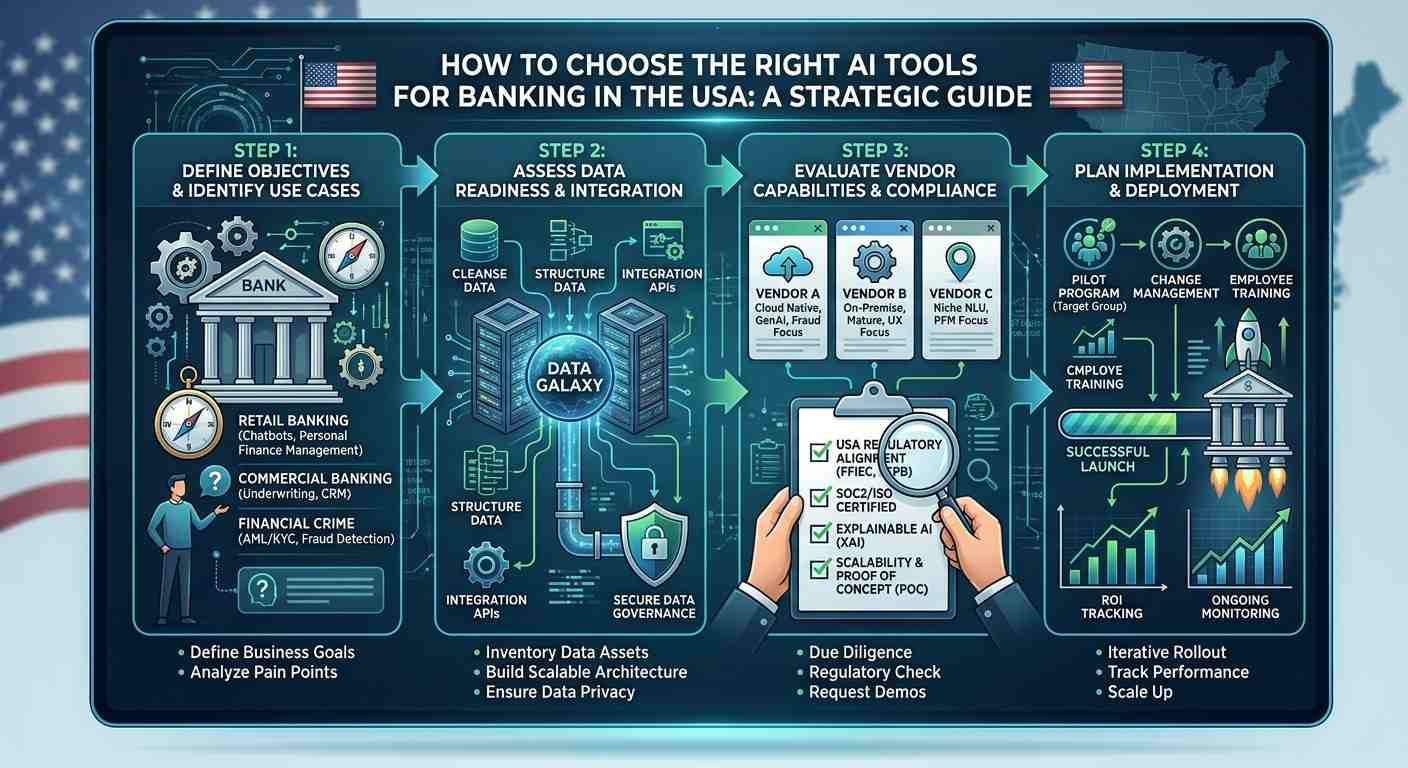
Selecting a banking AI solution starts with a clearly defined business problem. Buying software before identifying the problem can increase costs without delivering meaningful improvements.
1. Identify the Banking Use Case
Decide whether the priority is fraud detection, customer service, document processing, employee productivity, or another workflow. Compare products designed for that specific need.
2. Review Security and Data Privacy
Ask how customer data is stored, processed, encrypted, and accessed. Review retention policies, subcontractors, incident reporting, and whether submitted information can be used to train models.
3. Check Compliance Requirements
US financial institutions may need to consider applicable banking regulations, consumer protection rules, fair-lending obligations, recordkeeping, and third-party risk management. Requirements depend on the institution and use case.
4. Test Integration
Confirm that the platform can work with the bank’s existing systems, identity controls, monitoring tools, and approved data sources.
5. Run a Pilot
Test the tool with a limited group and measurable objectives. Compare the results with the current process before expanding deployment.
6. Evaluate Human Oversight
Define who reviews alerts, corrects errors, handles complaints, and approves consequential decisions. Establish a fallback process when the AI system is unavailable or uncertain.
Real-World Examples of AI in US Banking
Example 1: Fraud monitoring
A customer who usually makes small domestic purchases suddenly attempts several unusually large transactions. A fraud monitoring system can flag the activity for further checks. The bank then follows its approved verification and investigation procedures.
Example 2: Customer service automation
A customer asks when a deposited check will become available. A virtual assistant can explain general funds-availability policies using approved information. Account-specific answers should rely on secure systems and authenticated access.
Example 3: Loan document processing
A mortgage team receives income documents, bank statements, and application forms. An AI system can help extract information and identify missing documents. Qualified staff must verify the information and make decisions under applicable lending rules.
Example 4: Internal employee assistance
A branch employee needs the latest procedure for replacing a debit card. An internal AI assistant can locate relevant approved guidance, helping the employee find the right procedure more quickly.
These are illustrative use cases, not claims that every named vendor provides every feature out of the box.
FAQs About AI Tools for Banking
1. What are the best AI tools for banking in the USA?
The appropriate choice depends on the use case. Microsoft Azure AI and Google Cloud AI support custom AI applications, IBM watsonx focuses on enterprise AI capabilities, NICE Actimize specializes in financial crime technology, and Kasisto KAI focuses on conversational banking.
2. How do banks use AI to detect fraud?
AI systems analyze transaction patterns and other approved signals to identify activity that may be suspicious. They generate alerts for further review. Banks need controls to manage false positives and investigate alerts appropriately.
3. Are AI banking tools expensive?
Costs vary by provider, features, transaction volume, deployment model, and integration needs. Cloud services may charge according to usage, while specialist enterprise systems may require customized contracts. Request a detailed quotation before comparing total costs.
4. Is AI safe for US banks?
AI can support banking operations when implemented with appropriate security, testing, access controls, monitoring, and human oversight. No system is risk-free. Banks should assess privacy, cybersecurity, model errors, vendor risks, and relevant regulatory requirements.
5. Can small banks and credit unions use AI?
Yes. Smaller institutions can consider focused applications such as customer service assistance, document processing, and employee knowledge search. They should start with a manageable use case and evaluate cost, security, integration, and measurable benefits.
Conclusion:
AI tools for banking can help US financial institutions improve selected workflows, strengthen fraud monitoring, support employees, and provide more responsive digital services. The right platform depends on the bank’s objectives, technical environment, budget, and risk requirements.
Microsoft Azure AI and Google Cloud AI are options for institutions building custom AI applications. IBM watsonx may be relevant to organizations prioritizing enterprise AI development and governance. NICE Actimize is worth evaluating for financial crime and compliance needs, while Kasisto KAI is focused on conversational banking experiences.
The best choice is the platform that solves a defined banking problem safely and cost-effectively—not simply the one with the most features. Compare vendors against measurable performance goals, security requirements, integration needs, and total ownership costs. Start with a controlled pilot, involve compliance and security teams early, and expand only when results support the investment.
For more AI software comparisons and practical guides, visit ToolPromptHub and explore related articles before selecting a solution.